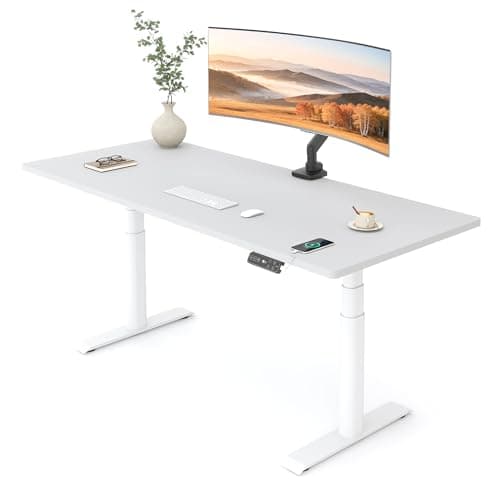
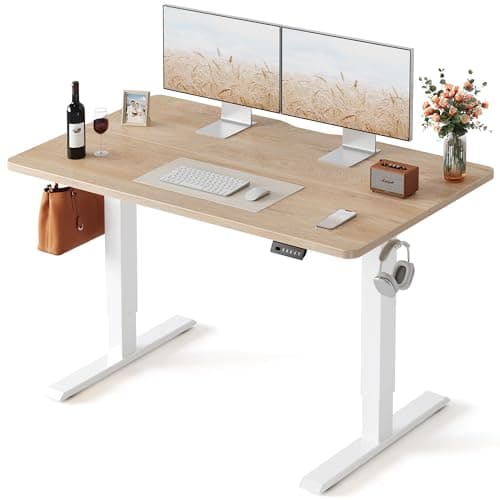
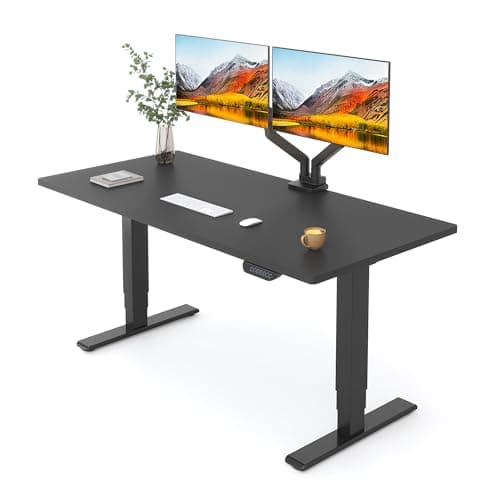
Under $500 the standing desk to buy is the FLEXISPOT E6 MAX: a dual-motor, three-stage frame under a 55 by 28 inch top, a published height range of about 24.4 to 50 inches, 330 lb of capacity and a ten-year warranty on the frame and motor. That is a specification sheet that used to start at twice this price. The budget pick is the FEZIBO Electric Standing Desk, 48 by 24 — the cheapest desk here that still raises itself with a motor instead of a crank. And if the problem is surface area rather than height, the Cubiker Reversible L-Shaped puts a 63 by 55 inch corner on a powered frame for well under half the cap.
Two numbers decide a standing desk at this price and neither of them is the width of the top. The first is how many motors lift it: one motor drives both legs through a shaft, which is slower, noisier and more prone to racking; two motors drive one leg each. The second is how many stages each leg has: a two-stage leg is two tubes, a three-stage leg is three, and the third tube is what buys both a lower minimum and a higher maximum from the same footprint. A three-stage desk is also noticeably more rigid at full extension, because less of each tube is unsupported.
The published numbers, side by side
| Desk | Surface | Lift | Published height range | Capacity |
|---|
| FLEXISPOT E6 MAX | 55 × 28″ | Dual motor, 3-stage | About 24.4 to 50″ | 330 lb |
| FlexiSpot E6 Pro | 55 × 28″ | Dual motor, 3-stage | 23.6 to 48.8″ | Not published |
| FEZIBO 55 × 26″ with drawers | 55 × 26″ | Electric | 28.35 to 46.46″ | Not published |
| FEZIBO L-Shaped 63 × 48″ | 63 × 48″ corner | Electric | 28 to 46″ | 176 lb (frame) |
| Cubiker Reversible L-Shaped | 63 × 55″ corner | Electric | Not published | Not published |
| FEZIBO 48 × 24″ | 48 × 24″ | Electric | Not published | Not published |
Four of the six publish no weight capacity and two publish no height range, and we have written those cells as gaps rather than filling them with a guess. The gaps matter in one direction specifically: a desk with no published minimum height is a risk if you are shorter than about 5′4″, and a desk with no published capacity is a risk if you are putting two heavy monitors and an arm on it. Standing desk weight capacity works through how to add up what you are actually loading.
The range is about you, not the desk
The useful way to read those height figures is against your own body, not against each other. Seated, you want the top at roughly elbow height with your shoulders relaxed; for most people between 5′4″ and 6′0″ that is somewhere between 25 and 29 inches. Standing, it is normally 10 to 13 inches higher. The desk height guide has the arithmetic with the measurements to take, and it is a five-minute job that saves a return.
Two consequences of the table above. The 28.35 inch minimum on the FEZIBO 55-inch desk is too high for a shorter user to sit at comfortably without raising the chair and adding a footrest. And the 50 inch maximum on the E6 MAX is the only figure here that comfortably clears 6′4″ standing — standing desks for tall people is the page if that is you.
What $500 does not buy on a complete desk
- A choice of top. Complete desks come with the top the maker chose, usually engineered wood or laminate. If you want a specific surface, size or material, buy the frame and the top separately — frame versus complete desk does that arithmetic, and the standing desk frames roundup ranks the frames on their own.
- A 15-year whole-desk warranty. The best term here is ten years on the frame and motor of the E6 MAX. The premium brands publish longer and cover the top too — UPLIFT desk alternatives covers what that is worth.
- Cable management. Nothing in this band ships with a tray, and a desk that moves 20 inches twice a day is the one place cable slack is not optional. Standing desk cable management is the method and the cable tray roundup is the part.
- Rigidity at full height, automatically. Three-stage legs help; so does a crossbar, which is why the budget FEZIBO has one. Standing desk wobble has the fixes in order of cost, starting with free.
Price check. 5 of the 6 picks below were listed under $500 on Amazon as of November 21, 2026— the figure on each buy button is the live one, and where we have no verified price we show none rather than a number that has rotted.
The short answer
Quick picks
| # | Product | Best for | Score | Price |
|---|
| 01 | | Best overall - every figure published | | $339.99·Amazon |
| 02 | | Lowest published minimum height | | $399.99·Amazon |
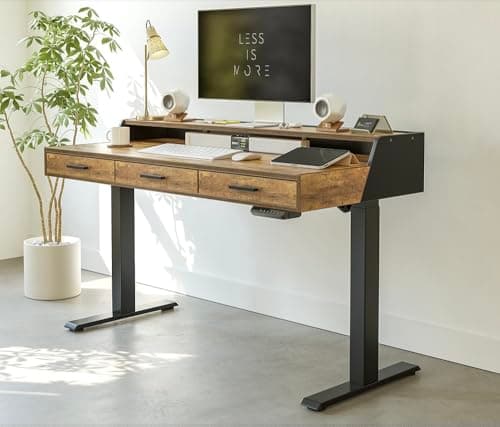
| 03 | FEZIBO 55×26" Standing Desk with DrawersThe pick if the desk has to hold the room's storage as well: three drawers and a monitor shelf under a 55-inch top, with three height presets. Its 28.35-inch minimum is the highest here, so check your seated number first. | Storage built in - drawers and a shelf | | Check price → |
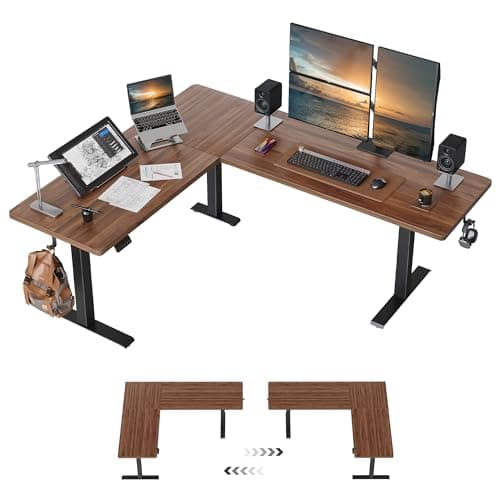
| 04 | FEZIBO L-Shaped Electric Standing Desk (63×48")A powered 63 by 48 inch corner with a published 28 to 46 inch range and a 176 lb frame rating - the only L-shape here that publishes both figures, which is why it outranks the cheaper corner desk. | Best corner desk with published figures | | $289.99·Amazon |
| 05 | | Most usable surface for the money | | $179.99·Amazon |
| 06 | FEZIBO Electric Standing Desk, 48 x 24The budget pick: the cheapest desk here that still raises itself with a motor rather than a crank, with a steel frame and a crossbar that does real work for rigidity at full height. | Budget pick - cheapest powered desk | | $94.98·Amazon |
#ad · Live prices from the Amazon Product API, as of November 21, 2026. Where we have no verified live price we show none — we would rather leave a gap than print a number that has rotted.
In detail
The picks, in full
Best overall - every figure published
FLEXISPOT E6 MAX Dual Motor Standing Desk (55" x 28")
- Surface
- 55" W x 28" D
- Weight capacity
- 330 lb
- Height range
- About 24.4 to 50 in
- Frame
- Dual motor, 3-stage legs
- Controller
- Memory presets with backlit keypad
- Warranty
- 10 years on the frame and motor
The only desk here that publishes every number that matters: dual motor, three-stage legs, about 24.4 to 50 inches of travel, 330 lb of capacity and ten years on the frame and motor - under a 55 by 28 inch top.
- Lift Mechanism
- 9.4
- Published Height Range
- 9.6
- Surface & Depth
- 9
- Value Under $500
- 8.6
Pros
- +A published 330 lb capacity, which is the figure a triple mount and a tower under the desk actually need
- +Reaches 50 inches - the highest published top end in this comparison
- +10 years on the frame and motor, which is the component that fails if anything does
- +28 inches deep, so monitor arms have somewhere to clamp behind the screens
Cons
- −Goes nearly two inches higher than the UPLIFT at the top and nearly two inches less low at the bottom - the wrong trade if you are short
- −Fixed top, same as the E6 Pro: no edge or finish choices
- −Costs more than the E6 Pro for a capacity figure most desks never approach
- −flexispot.com returned 404 for this model's product page this run, so these are the listing's published figures rather than the maker's page today
Skip this if…
…your desk holds one or two monitors and a laptop - the E6 Pro does that job for less money.
Lowest published minimum height
FlexiSpot E6 Pro Dual-Motor Standing Desk (55×28")
- Surface
- 55" W x 28" D
- Height range
- Dual-motor 3-stage, 23.6 to 48.8 in
- Motor
- Dual motor
- Controller
- 4-position memory keypad
- Top
- One-piece slab top, white
The same dual-motor, three-stage architecture with the lowest published minimum on this page - 23.6 inches - which makes it the pick for a shorter user or anyone who wants to sit genuinely low.
- Lift Mechanism
- 9.2
- Published Height Range
- 9
- Surface & Depth
- 9
- Value Under $500
- 8.6
Pros
- +Dual motors lift quickly and quietly, and share the load for less flex
- +Range covers low sitting to tall standing for most heights
- +Four memory presets recall your seated and standing heights
- +Priced below the premium frames while matching most of what matters
Cons
- −FlexiSpot publishes no material for the top, only that it is a single slab rather than spliced
- −Some sway appears near the very top of the range, as with any lifting desk
Skip this if…
…you want a fully bespoke top, edge, and finish rather than a fixed configuration.
Storage built in - drawers and a shelf
FEZIBO 55×26" Standing Desk with Drawers
- Surface
- 55" W x 26" D
- Height range
- Electric, 28.35 to 46.46 in
- Motor
- Electric, with three height memory presets
- Storage
- Three wood drawers under the top, plus a monitor shelf
- Top
- Engineered wood, rustic brown
The pick if the desk has to hold the room's storage as well: three drawers and a monitor shelf under a 55-inch top, with three height presets. Its 28.35-inch minimum is the highest here, so check your seated number first.
- Lift Mechanism
- 7.6
- Published Height Range
- 7
- Surface & Depth
- 8
- Value Under $500
- 8
Pros
- +Three integrated drawers save a separate cabinet in a small room
- +A 26-inch depth fits tighter spaces than a 28-inch top, and the monitor shelf lifts a screen to eye level without an arm
- +Three memory presets for quick sitting and standing recall, and the casters detach and lock
Cons
- −Drawers add weight and eat some knee clearance underneath
- −It ships in two packages, so assembly waits on both boxes arriving
Skip this if…
…you need maximum knee room and the fastest, steadiest lift.
Best corner desk with published figures
FEZIBO L-Shaped Electric Standing Desk (63×48")
- Surface
- 63" x 48" L-shape (corner)
- Height range
- Electric, 28 to 46 in, with 2 memory presets
- Motor
- Electric lift with memory presets
- Top
- Engineered wood, two-piece corner
- Capacity
- Frame rated to 176 lb
A powered 63 by 48 inch corner with a published 28 to 46 inch range and a 176 lb frame rating - the only L-shape here that publishes both figures, which is why it outranks the cheaper corner desk.
- Lift Mechanism
- 7.4
- Published Height Range
- 7.6
- Surface & Depth
- 9.2
- Value Under $500
- 8.2
Pros
- +Wraps a corner and gives two working zones on one desk
- +Electric height change means it doubles as a standing desk
- +Memory presets recall your sitting and standing heights
- +A lot of usable surface for the footprint of one corner
Cons
- −Heavier and slower to assemble than any fixed desk here
- −An L-shaped top can sway more at full standing height than a straight one
- −Costs more than the fixed desks by a wide margin
Skip this if…
…you do not have a corner to build it into.
Most usable surface for the money
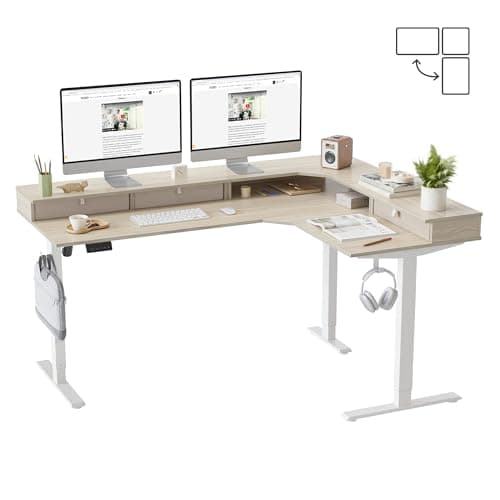
Cubiker Reversible L-Shaped Electric Standing Desk, 63 x 55
- Footprint
- 63" x 55" L-shape
- Adjustment
- Electric height adjustment
- Orientation
- Reversible configuration
- Frame
- Multi-leg powered frame supporting both arms
- Surface
- Laminate desktop
The most surface per dollar on this page by a wide margin: a reversible 63 by 55 inch corner on a powered frame for a fraction of the cap. Cubiker publishes no height range or capacity, and that is the trade.
- Lift Mechanism
- 7
- Published Height Range
- 5.5
- Surface & Depth
- 9.4
- Value Under $500
- 9
Pros
- +Gets you both the corner shape and a sit-stand range, which very few desks do
- +Multi-leg frame keeps a large L-shaped top stable through the travel
- +Reversible, so the return lands on the correct side of the room
- +Costs less than many straight electric desks of similar surface area
Cons
- −A powered L has more to go wrong than a fixed one, and more to level at assembly
- −Cable management is harder: two arms of cabling that all have to travel vertically
- −Heavier and more involved to assemble than any fixed desk here
Skip this if…
…you will not actually change the height — a fixed L is cheaper, simpler, and more rigid
Budget pick - cheapest powered desk
FEZIBO Electric Standing Desk, 48 x 24
- Size
- 48" x 24" desktop
- Adjustment
- Electric height adjustment
- Frame
- Steel frame with crossbar
- Controller
- Push-button height control
- Assembly
- Frame bolts to a pre-drilled top
The budget pick: the cheapest desk here that still raises itself with a motor rather than a crank, with a steel frame and a crossbar that does real work for rigidity at full height.
- Lift Mechanism
- 7.2
- Published Height Range
- 6
- Surface & Depth
- 7
- Value Under $500
- 9.6
Pros
- +Steadier at full height than most desks at this price, which is the specification that matters
- +48 by 24 inches suits a single monitor or a modest dual setup without dominating a room
- +Full electric adjustment rather than a crank, so you will actually use it
- +Pre-drilled top makes assembly genuinely quick
Cons
- −Single motor, so the lift is slower and less rigid than a dual-motor frame
- −24 inches deep is shallow for a large monitor — you may sit closer than ideal
- −Short warranty compared with premium frames
Skip this if…
…you are mounting two large monitors on an arm — the load and the depth both become limiting
Dual motor or single motor, in practice
A single-motor desk drives both legs from one motor through a connecting shaft. It works, it is cheaper, and the two things you notice are speed and racking: it lifts more slowly, and if the load is lopsided the legs can go out of step slightly, which shows up as a top that is not quite level. A dual-motor desk gives each leg its own motor and a controller that keeps them synchronised, which is quieter, faster and squarer under an uneven load — and an uneven load is the normal case the moment two monitors sit on one side. Electric versus manual covers the step below this one, which is whether you want a motor at all.
Depth is the specification people regret
Width gets the attention and depth decides whether the desk works. A 24-inch top puts a 27-inch monitor closer than most people want to read it; 26 inches is workable with a monitor arm pushing the panel back over the edge; 28 inches is comfortable with the stand still on. Two of the picks here are 28 inches deep, two are 26 or less, and the two L-shapes get their depth from the corner instead. The desk depth guide has the viewing-distance arithmetic, and monitor height ergonomics is the other half of getting the screen where your eyes want it.
An L-shape is a different purchase
Both corner desks here cost less than the rectangular dual-motor picks, and that is not a bargain so much as a different product. You are buying surface area and losing the published specifications: neither publishes a height range we could read, the FEZIBO publishes a 176 lb frame rating, and a corner frame has more joints to go out of square. Buy one because the room is a corner, not because the number is lower. The L-shaped desks roundup ranks that field properly, including fixed-height options with far better tops for the money.
Three cheap things to buy with it
- An anti-fatigue mat. The single highest-value accessory for a desk that goes up, because standing on a hard floor is what makes people stop standing. The mats roundup has the field.
- A monitor arm. A screen on a stand has to be re-aimed every time the desk moves; a screen on an arm does not, and the arm hands back the depth the stand base was using. Arms under $100 is the right page at this budget.
- A clamp-on power strip. So the desk lifts its own power with it instead of pulling a wall socket. Desk power strips covers the clamp-mounted ones.
How we picked
We do not run a testing lab
We compiled the published manufacturer specifications, did the ergonomics, VESA and desk-depth math ourselves, and read aggregated owner reviews, then scored each product against a published rubric. The scores are judgments from documented research — they are not measurements we took, because we do not have a lab and we are not going to pretend we do. Every spec traces back to a listing or manual named in Sources.
Questions
Frequently asked
Is a standing desk under $500 any good?+
Now, yes. Two desks on this page publish dual-motor, three-stage frames, which is the specification that used to start at nearly twice this cap. What you still do not get at this price is a choice of top, a 15-year whole-desk warranty, or cable management - and two of the six publish no height range or weight capacity at all, which is the real risk at the bottom of the band.
Dual motor or single motor for a standing desk?+
Dual, if the budget reaches it. Each leg gets its own motor and the controller keeps them synchronised, so the desk lifts faster, quieter and squarer under an uneven load - and an uneven load is the normal case as soon as two monitors sit on one side. A single motor is not a defect; it is slower and more prone to going slightly out of square.
What height range do I need on a standing desk?+
Seated, the top should sit at about elbow height with your shoulders relaxed - roughly 25 to 29 inches for most people between 5′4″ and 6′0″. Standing is normally 10 to 13 inches higher. Check your own two numbers against the published range before you order:
the desk height guide has the measurements, and the 28.35-inch minimum on one desk here is already too high for some users.
Is it better to buy a frame and a top separately?+
If you want a specific surface or size, yes, and often for similar money - a frame plus a top you choose is the standard enthusiast route.
Frame versus complete desk runs the numbers both ways. A complete desk wins on one thing: the top is pre-drilled, so the build is an hour rather than an afternoon.
Receipts
Sources
We do not run a testing lab, and we do not pretend to. Specifications come from the manufacturer or retailer listing; the footprint and clearance math is ours and reproducible. Where we could not verify a number, we say so on the page rather than quietly leaving it out. Read our full method.