Standing desks fail in a predictable way. People buy one, use it standing for a week, discover that eight hours upright is its own kind of tiring, and quietly stop raising it. The desk goes back down and stays down, and the whole investment turns into an expensive fixed-height desk. The fix is not more willpower. It is a chair that works at standing height, so that “down” is not the only comfortable option.
That chair is a drafting chair, and it exists because drafting tables and workbenches have always been tall. A normal office chair tops out around a seat height suited to a 29-inch desk. A drafting chair carries on upward, and adds the one component a tall chair cannot work without: a foot ring. Without somewhere to put your feet, a tall chair leaves your legs dangling, which cuts circulation at the back of the thigh and puts all your weight on a small area. The ring is not a styling detail. It is the reason the chair is usable.
There are two formats and they suit different intentions. A full drafting chair is an office chair on a taller cylinder with a foot ring, complete with a backrest and armrests, and it is meant for genuine sitting at standing height. A leaning or perching stool is a different idea — it takes some of your weight while you remain essentially upright, which keeps the posture active and is meant for alternating rather than settling. Choose the drafting chair if you want to properly sit high; choose the leaning stool if you want to stand more comfortably for longer.
Before you buy either, measure. Get the desk to the height you actually use standing, measure from the floor to the underside of the desktop, then subtract roughly ten to twelve inches for thigh clearance and comfortable arm position — that is your target seat height, and it must fall inside the chair’s stated range rather than at its extreme. Our standing desk roundup covers the desk side of the same measurement. Scores follow how we pick.
The short answer
Quick picks
#ad · Live prices from the Amazon Product API, as of October 23, 2026. Where we have no verified live price we show none — we would rather leave a gap than print a number that has rotted.
In detail
The picks, in full
Best overall
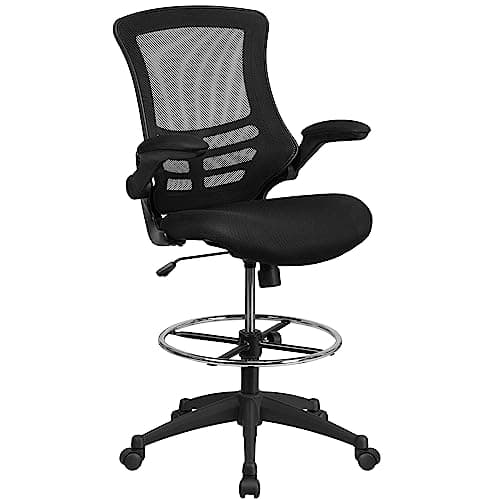
Flash Furniture Mesh Adjustable Ergonomic Drafting Chair
- Type
- Full drafting chair with backrest
- Foot ring
- Height-adjustable foot ring
- Back
- Breathable mesh back
- Seat
- Padded seat with pneumatic height adjustment
- Base
- Five-point caster base
The straightforward answer. A mesh-backed drafting chair with an adjustable foot ring and a height range that genuinely covers a standing desk, at a price that does not undermine the point.
- Height Range
- 9
- Foot Support
- 9.2
- Comfort
- 7.6
- Value
- 9
Pros
- +Adjustable foot ring means the ring moves with the seat rather than fighting it
- +Mesh back keeps it cool, which matters more on a chair used in short bursts between standing
- +Height range genuinely reaches standing-desk territory rather than stopping just short
- +Priced so that adding it to a standing desk is a small decision
Cons
- −Seat padding is modest; this is a chair for intervals, not eight-hour sessions
- −Armrests are basic and not multi-axis adjustable
- −Casters on a hard floor at this height can feel skittish until you get used to it
Skip this if…
…you intend to sit in it all day — a drafting chair is for alternating, not for replacing your main chair
Best leaning stool
Mount-It! Ergonomic Sit-Stand Leaning Stool
- Type
- Leaning or perching stool
- Height
- Adjustable for standing-desk heights
- Base
- Weighted tilting base
- Posture
- Keeps hips open and the spine near-upright
- Footprint
- Small; tucks away when not in use
The other philosophy, executed well. A leaning stool that takes part of your weight while keeping you essentially upright, which is what most standing-desk users actually want between standing and sitting.
- Height Range
- 8.8
- Foot Support
- 7
- Comfort
- 7.8
- Value
- 8
Pros
- +A perching posture keeps the hips open and the spine closer to standing alignment than sitting does
- +Tilting base lets you shift and move rather than locking into one position
- +Small enough to push aside entirely when you want to stand properly
- +Genuinely extends how long standing at the desk stays comfortable
Cons
- −No backrest at all, which is the deliberate design and also its limitation
- −Not suitable for long stationary sessions
- −Takes a few days to stop feeling precarious
Skip this if…
…you want back support — this is a standing aid rather than a chair, and it never pretends otherwise
Best back support
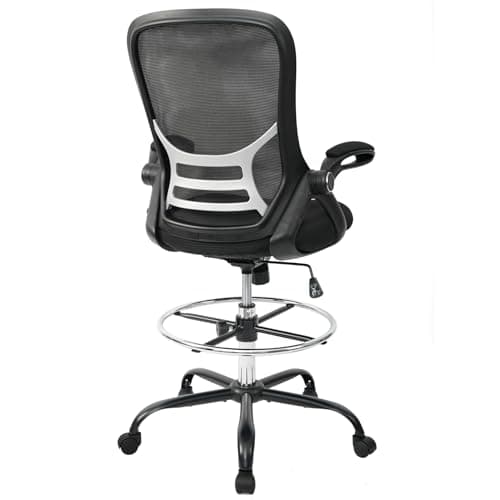
HYLONE Drafting Chair, High-Back Mesh Standing Desk Chair
- Type
- High-back drafting chair
- Back
- High mesh back with lumbar shaping
- Foot ring
- Adjustable foot ring
- Seat
- Pneumatic height adjustment into standing-desk range
- Armrests
- Flip-up armrests
The pick if you want a proper backrest at standing height. A high-back mesh drafting chair that keeps the support of a normal office chair while reaching the height a standing desk needs.
- Height Range
- 8.8
- Foot Support
- 8.8
- Comfort
- 8.6
- Value
- 8.2
Pros
- +High back means you can actually lean back, which most drafting chairs do not allow
- +Flip-up arms let it tuck under a standing desk when raised
- +Adjustable foot ring at a height that suits taller users
- +The closest thing here to a normal ergonomic chair that also goes high
Cons
- −Tall back plus tall base makes it a visually large object in a small room
- −Heavier and less easy to move aside than a stool
- −Mesh tension is fixed with no way to firm it later
Skip this if…
…you want something you can push out of the way in a second — this is a full chair and behaves like one
Best for all-day high sitting
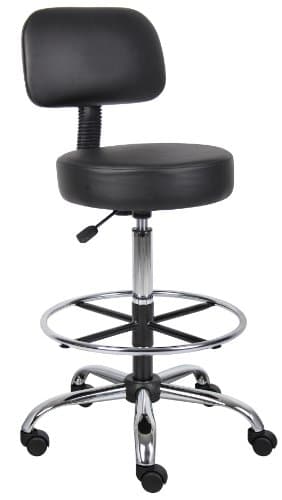
Boss Office Products Be Well Medical Spa Drafting Stool
- Type
- Drafting stool with back support
- Intended use
- Medical, salon, and workbench environments
- Foot ring
- Chrome foot ring
- Seat
- Contoured seat with pneumatic lift
- Base
- Caster base rated for continuous use
Built for people who sit high all day for a living. A medical and salon-grade stool with a small supportive back and a foot ring, which is a different design brief from a home-office accessory.
- Height Range
- 8.4
- Foot Support
- 9
- Comfort
- 8
- Value
- 8.6
Pros
- +Designed for professionals who sit at height for entire shifts, which shows in the seat and base
- +Small back support hits the lumbar without getting in the way of reaching forward
- +Simple, durable construction with few parts to fail
- +Wipe-clean upholstery, which suits a workbench as much as a desk
Cons
- −Utilitarian appearance that suits a workshop more than a living room
- −No armrests
- −Limited recline — it holds you upright and working
Skip this if…
…you want a chair to relax in — this is a work stool and it keeps you in a working posture
Best value
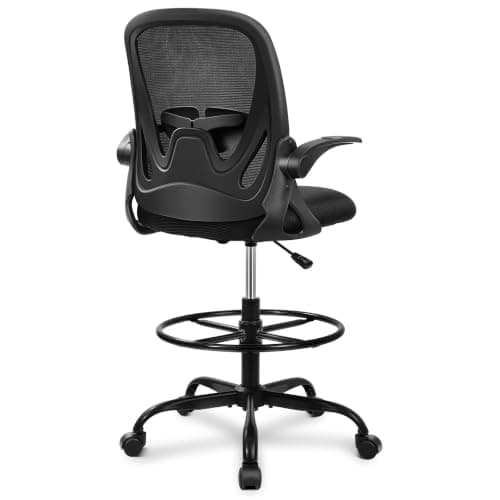
Primy Drafting Chair with Flip-Up Armrests
- Type
- Tall office chair with drafting height range
- Armrests
- Flip-up armrests
- Foot ring
- Foot ring included
- Seat
- Padded seat with pneumatic lift
- Back
- Mid-height supportive back
The value pick with the useful detail: flip-up armrests, which is what lets a tall chair tuck fully under a raised desk instead of jamming against the underside.
- Height Range
- 8.6
- Foot Support
- 8
- Comfort
- 7.6
- Value
- 9.2
Pros
- +Flip-up arms solve the specific problem of a tall chair not fitting under a raised desk
- +Foot ring included rather than sold as an accessory
- +Comfortable enough for longer intervals than a leaning stool allows
- +One of the least expensive proper drafting chairs here
Cons
- −Materials and finish are clearly built to a price
- −Foot ring adjustment is coarser than the better picks
- −Back support is adequate rather than good
Skip this if…
…you need fine height adjustment on the foot ring, which is where this one is most obviously basic
How to choose a drafting chair
Measure before you shop, because height range is the specification that decides everything and it is the one people guess at. Raise your desk to the height you actually use standing and measure from the floor to the underside of the desktop. Subtract roughly ten to twelve inches for thigh clearance and a comfortable arm position, and that is the seat height you need. Check it falls comfortably inside the chair’s range rather than at its very top, because a gas lift held at maximum is a gas lift that sinks.
Then treat the foot ring as a requirement rather than a feature. A tall chair without one leaves your feet unsupported, which compresses the back of your thighs and concentrates your weight badly. An adjustable ring is meaningfully better than a fixed one, because it moves with the seat as you change height rather than being right at only one setting.
Decide next between a chair and a stool, and be honest about how you will actually use it. A full drafting chair with a back is for genuinely sitting at height for stretches. A leaning stool is for taking the edge off standing while staying upright and active, and it has no backrest by design. People who buy a stool expecting a chair are disappointed, and the reverse is also true. If you are not yet sure a tall chair is the right purchase, office chair versus drafting chair puts the published seat-height numbers side by side — even the highest-seat task chair we rank stops at 22.25 inches, which is nowhere near a raised desk.
Finally, plan for the floor and for the tuck. Casters at this height feel livelier than on a normal chair, so on hard floors consider locking or braked casters, or a mat. And check that the chair will actually go under your desk when raised — flip-up armrests are the detail that makes this work, and it is easy to overlook until you are wheeling a chair into the underside of a desktop. Pair it with an anti-fatigue mat for the standing half of the day, and the whole sit-stand cycle finally works as intended.
How we picked
We do not run a testing lab
We compiled the published manufacturer specifications, did the ergonomics, VESA and desk-depth math ourselves, and read aggregated owner reviews, then scored each product against a published rubric. The scores are judgments from documented research — they are not measurements we took, because we do not have a lab and we are not going to pretend we do. Every spec traces back to a listing or manual named in Sources.
Questions
Frequently asked
What is a drafting chair?+
It is an office chair on a taller gas cylinder with a foot ring, originally made for drafting tables and workbenches. The extra height lets it work at a standing desk or high bench, and the foot ring gives your feet somewhere to rest so your legs are not left hanging.
Do I need a drafting chair for a standing desk?+
If you want to use the top half of the desk's range regularly, yes. Without a tall chair, standing is the only option at standing height, and most people give up and leave the desk down. A tall chair is what makes alternating practical.
How tall should a drafting chair be?+
Measure from the floor to the underside of your desktop at standing height and subtract roughly ten to twelve inches. That is your target seat height, and it should sit inside the chair's range rather than at its maximum — a cylinder held at full extension tends to sink.
Is a leaning stool better than a drafting chair?+
They do different jobs. A leaning stool takes some weight while keeping you near-upright and active, with no backrest, which suits alternating through the day. A drafting chair is for genuinely sitting at height for longer stretches. Buy the one that matches how you actually work.
Why does a drafting chair need a foot ring?+
Because at that height your feet do not reach the floor. Unsupported legs put pressure on the back of the thighs and concentrate your weight on a small area, which becomes uncomfortable quickly. The ring gives your feet a base and lets you shift position.
Receipts
Sources
We do not run a testing lab, and we do not pretend to. Specifications come from the manufacturer or retailer listing; the footprint and clearance math is ours and reproducible. Where we could not verify a number, we say so on the page rather than quietly leaving it out. Read our full method.