Buy electric unless you have no outlet where the desk goes, or you are buying a height-adjustable desk to set once and leave. That is the whole recommendation, and it rests on a single observation: a standing desk only works if you change position, and the thing that stops people changing position is friction, not conviction.
The comparison, on what actually differs
| | Electric (dual motor) | Manual (hand crank) |
|---|
| Time per height change | Around 7 seconds, one button | Around 30 seconds of cranking |
| Memory presets | Standard, usually 3 or 4 | None — height is found by eye each time |
| Typical weight capacity | 220–330 lb | Around 130 lb |
| Typical height range | 23.5″ to 49″ (3-stage) | 27.8″ to 46.5″ |
| Failure points | Motors, control box, handset, cable | Crank gear, effectively |
| Needs mains power | Yes, permanently | No |
| Cable management | Harder — the desk moves and carries a power lead | Same movement problem, one fewer cable |
The friction argument, in detail
The purpose of a sit-stand desk is not to stand. It is to change position several times a day, because holding any one posture for hours is what actually causes trouble. That makes the number of seconds between deciding to change and being at the new height the most important specification on the desk, and it is the one nobody publishes.
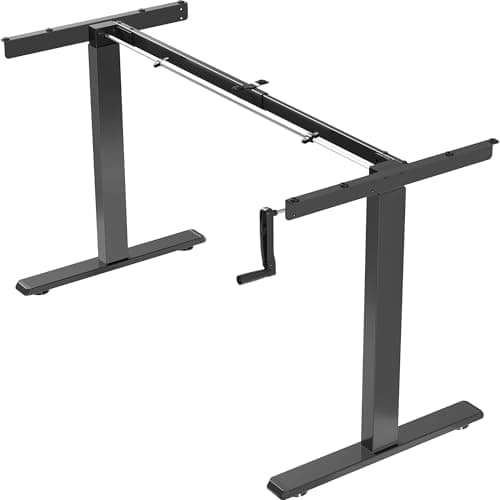
On an electric frame with presets, the sequence is: press a button, keep reading, the desk arrives. Nothing is interrupted. On a crank, the sequence is: stop, clear the crank handle, turn it forty or fifty times, judge the height by eye, sit or stand, discover it is an inch off, turn it some more. That is a task, and tasks get skipped. The consistent pattern in owner reports of crank desks is not that they broke — it is that they stopped moving.
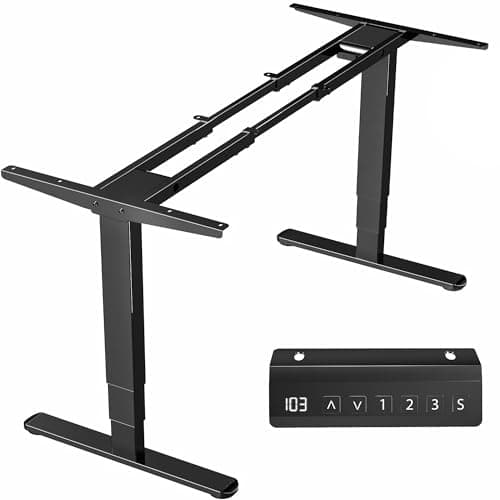
The corollary is that presets matter almost as much as motors. An electric desk with only up and down buttons still requires you to judge the height by eye each time, which reintroduces a chunk of the friction. If you are buying electric, buy presets.
Weight capacity is not a tie
A dual-motor frame is rated 220 lb or more; the crank frame here is rated 132 lb. A realistic desk load is well under either number — two monitors, an arm, a dock, a laptop and clutter is 60 to 80 lb — so the crank will lift it. But the crank gets harder to turn as the load rises, in a way that motors do not, so a heavier load makes the friction problem worse. On a three-screen mount, or with a heavy ultrawide arm, the crank stops being pleasant well before it stops being possible.
Reliability: the honest version
The reliability argument for a crank is real but narrower than it sounds. Electric frames do have more failure points, and the control box is the usual culprit. But those parts are replaceable and cheap relative to the desk, and reputable makers cover them for three to five years. A crank frame’s advantage is that it will still work in year twelve without anyone having had to find a part number.
Where that genuinely matters is a desk in a garage, workshop or outbuilding — no convenient outlet, dust and humidity that motors dislike, and no appetite for chasing a replacement handset. That is the crank’s proper habitat, and it is a real one.
The cost gap is smaller than it looks
A manual frame is cheaper than an electric one, but the comparison people make is usually wrong: a bare manual frame still needs a tabletop, and the single-motor bundled electric desks now start close to that combined figure. Before deciding on price, price the whole desk both ways. The frame-only route is covered in the standing desk frame roundup, and the bundled options are in best budget standing desks and converters. That price comparison is the whole subject of standing desk frame versus complete desk, which also covers the pre-drilled top you give up by going frame-only.
The verdict
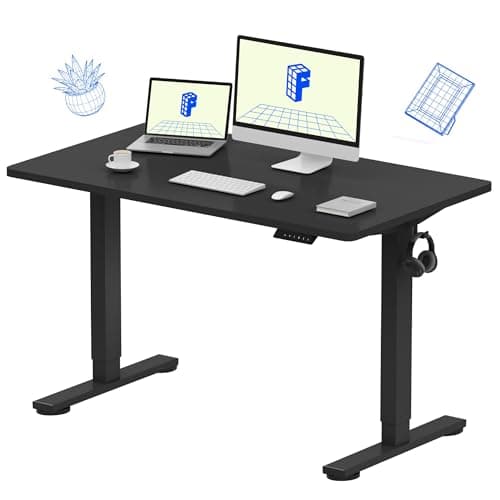
Buy electric if the desk lives in a room with an outlet and you intend to change position during the day. Buy it with memory presets rather than plain up-down buttons, and buy dual motors if a monitor arm is going on top. This is the answer for the overwhelming majority of desks.
Buy manualif there is no power where the desk goes, if the environment is unkind to electronics, or if you want height adjustment as a one-time setup rather than a daily habit — setting a desk precisely to your elbow height once and leaving it there is a completely legitimate use, and a crank does it for less money.
Buy neither if you already have a desk you like at the right height and only want to stand occasionally. A converter that sits on top of the existing surface is cheaper than replacing a working desk, and those are covered in best budget standing desks and converters. The broader case for standing at all is in standing desk vs sitting.
Whichever you choose, set the presets from a measurement rather than by feel — the seated and standing numbers follow from your elbow height, and they are in the desk height guide. And plan the cabling before the desk moves for the first time: cable management for a standing desk is the difference between a desk that travels and a desk that pulls its own plug out.