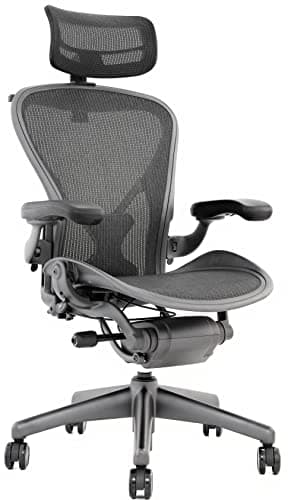
People treat this as a good-better question and it is not. The Aeron and the Embody are the same company’s answers to two different convictions about what a chair should do, and the more expensive one is not the better one — it is the one built around the other idea. Choosing between them means deciding which idea describes your back.
The Aeron is a suspension chair. There is no foam anywhere in it. You sit in a tensioned elastomeric membrane stretched across a frame, which distributes your weight over the whole contact area and lets air move through freely. Its posture philosophy is support: the chair holds you in a good position and expects you to stay roughly in it. It comes in three discrete sizes, which is unusual and important, because it means the fit is chosen at purchase rather than adjusted afterward.
The Embodyis a different animal. Its back is a matrix of pixels on flexible ribs that move independently, so the backrest reshapes continuously as you shift — the design intent is that it follows your spine rather than bracing it. The seat uses layered foam over a similar pixel structure. Its posture philosophy is movement: it wants you to shift position through the day and adapts as you do. One size, adjusted to fit.
Everything else follows from those two positions. The Aeron runs cooler, because a mesh membrane cannot trap heat the way foam does. The Embody suits people who fidget and people whose backs prefer to be followed than held. The Aeron’s three sizes mean small and large bodies get a real fit rather than an average one; the Embody’s single size is a broader compromise. And the Embody costs meaningfully more.
Both come with Herman Miller’s long warranty, both have available spare parts, and both hold their value on the used market to a degree no budget chair approaches — which is the argument for either over a cheap chair replaced every three years. If you are also considering the other side of the premium market, our Herman Miller versus Steelcase comparison covers that question. Judgments here come from published specifications, manufacturer documentation, and aggregated owner reports, per how we pick— we have not sat in these for a year in a lab.
The decision, field by field
How you sit.This is the field that decides it. If you settle into one good position and stay roughly there, the Aeron’s suspension holds you there comfortably and cheaply by comparison. If you shift constantly — crossing legs, leaning, perching forward and back — the Embody’s ribs follow you in a way the Aeron does not, and that is what you are paying for.
Temperature. The Aeron wins outright, and it is not close. A tensioned mesh membrane with no foam behind it simply cannot trap heat. If your room runs warm, or you do, this single field may settle the question regardless of the others.
Fit. The Aeron wins for bodies outside the middle, because three physical sizes is a genuinely different thing from one size with a wide adjustment range. If you are notably small or notably large, size B versus A or C is a real fit, while the Embody is asking you to adjust an averaged chair. If you are middling, this field is a draw.
Seat edge.The Embody wins. The front edge of the Aeron’s seat is a firm mesh frame, and a minority of people feel it under the thighs, particularly shorter users whose legs contact it more. The Embody’s layered foam is more forgiving there. If you have disliked mesh seats before, this is your field.
Price and resale. The Aeron wins. It costs less new, and its used-market demand is the strongest of any office chair, so the real cost of ownership over a decade is lower. Both carry the same long warranty and both have parts available years later, which is the actual argument for either over three consecutive budget chairs.
The verdict
For most people, the Aeron. It is cheaper, cooler, sized properly, and the suspension support suits the way most people actually sit. Choose the Embody if you shift position constantly, if you are managing an existing back complaint that a following backrest may suit better, or if you have found mesh seat edges uncomfortable in the past — and accept that you are paying more for a warmer chair in a single size. Whichever you pick, buy the right size and set it up properly; a premium chair set up badly is worse than a mid-priced chair set up well.