Skip to content
Chair & Cable

SECTION 03 · Ergonomic Chairs

The Best Under-Desk Footrests

If raising your chair to reach the desk left your feet hanging, you do not need a different chair. You need four inches of platform under them.

By Stephen V.Updated How we pick
#ad

We earn a commission when you buy through our Amazon links, at no extra cost to you. It never affects our rankings, and we say so when the cheaper product is the better buy. How this works.

A footrest exists to solve one specific problem, and it is worth being clear about what it is. Standard desks are around 29 inches tall, which is too high for a lot of people. To type comfortably you raise the chair until your elbows are near 90 degrees — and now your feet do not reach the floor. Dangling feet put pressure on the underside of your thighs, cut circulation, and pull you forward off the backrest, which quietly undoes whatever your chair was doing for your lower back. A footrest puts the floor back where your feet are.

Measure the gap before you shop

Sit at your desk in the position you actually work in, with your elbows at roughly 90 degrees and your shoulders relaxed. Now look down. The distance from the soles of your feet to the floor is the lift you need, and for most people in this situation it is between two and six inches. That number is the spec to shop against, and it is the one thing that separates a footrest that helps from one that changes nothing.

Two things follow from it. If your gap is small — two or three inches — almost anything works, including a stack of books, and the adjustable picks give you room to fine-tune. If your gap is large, you need a footrest whose range actually reaches it, which rules out most fixed foam wedges. And if there is no gap at all, you do not need a footrest; you need to check whether your desk is the wrong height in the other direction, which is covered in how high should your desk be.

Angle matters as much as height

A flat platform at the right height supports your feet but holds your ankles at a single fixed angle for eight hours. A tilted platform — typically somewhere between 10 and 30 degrees — puts the ankle in a more neutral position and lets the calf lengthen. This is why the picks with adjustable tilt score higher here than flat blocks at the same height: the adjustment is not decorative.

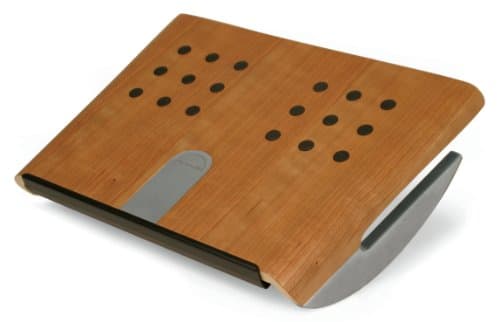
The related feature is movement. A rocking or rolling platform lets you flex your ankles through the day, which keeps blood moving in the lower legs. That is the entire design premise of the Humanscale FM300 and a large part of why it is the pick despite costing several times what the others do. If you would rather brace your feet firmly against something while you type, that is a legitimate preference and a static platform is the right answer.

Where a footrest is the wrong purchase

  • Your desk adjusts. If you have a height-adjustable desk, lower the desk instead. A footrest is a workaround for a desk you cannot change.
  • The problem is the chair.If your feet reach the floor fine and your back still aches, the issue is lumbar support or seat depth, not foot height — see chairs for back pain.
  • You stand most of the day. A footrest does nothing standing; an anti-fatigue mat is the equivalent purchase.
  • There is a drawer pedestal in the way. Measure the clear space under your desk first. A large platform footrest needs roughly 18 inches of clear width, which a desk with drawers may not leave you.

How this list is ranked

Height range first, because a footrest that does not reach your gap solves nothing; then movement and angle adjustment; then build; then value. Dimensions and ranges come from the manufacturers’ published specifications, and the ergonomic reasoning follows OSHA and NIOSH workstation guidance rather than measurements from a lab we do not have — see how we pick.

The short answer

Quick picks

#ProductBest forScorePrice
01
Humanscale Humanscale FM300 Foot Machine Footrest
Humanscale FM300 Foot Machine Footrest

The one that lets your feet keep moving. A hardwood platform on ball-bearing rollers rocks like a rocking chair does, which is the point - a static footrest supports your legs, this one also keeps the calf muscles working.

Best overall
8.6
$119.00Amazon
02
StarTech.com StarTech Under Desk Foot Rest (FTRST1)
StarTech Under Desk Foot Rest (FTRST1)

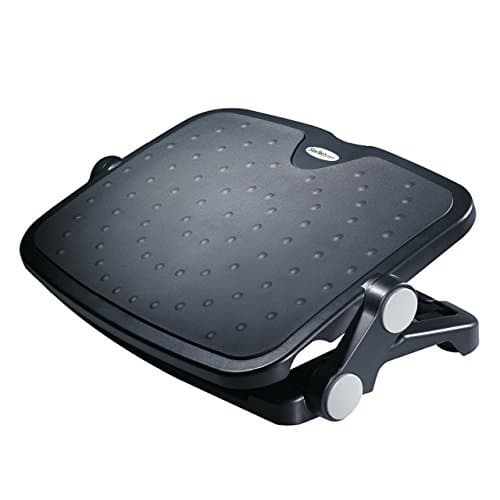
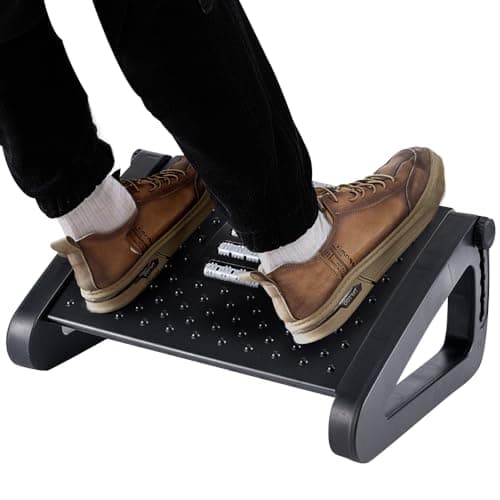
The best combination of size, angle adjustment, and price. An 18 by 14-inch platform is genuinely large, and two tilt ranges mean you can set the ankle angle rather than accept one.

Best value
8.6
$46.24Amazon
03
CasaZenith CasaZenith Six-Height Adjustable Foot Rest
CasaZenith Six-Height Adjustable Foot Rest

Six discrete height settings for the price of a takeaway. If your problem is specifically that the desk is too tall and you need to find the right lift by trial and error, this is the cheapest way to do it.

Most height settings for the money
7.9
$19.99Amazon
04
Everlasting Comfort Everlasting Comfort Memory Foam Under-Desk Foot Rest
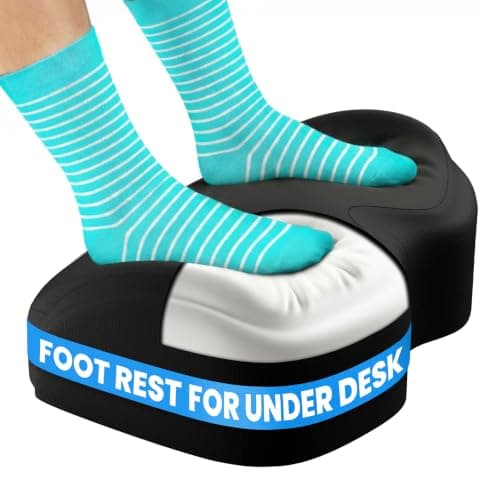
Everlasting Comfort Memory Foam Under-Desk Foot Rest

A foam wedge rather than an adjustable platform, and the right answer if the problem is pressure and leg fatigue rather than a desk that is too tall. It elevates and cushions; it does not adjust.

Best for leg fatigue
7.2
$23.99Amazon
05
iMissiu iMissiu Foot Hammock Under-Desk Footrest
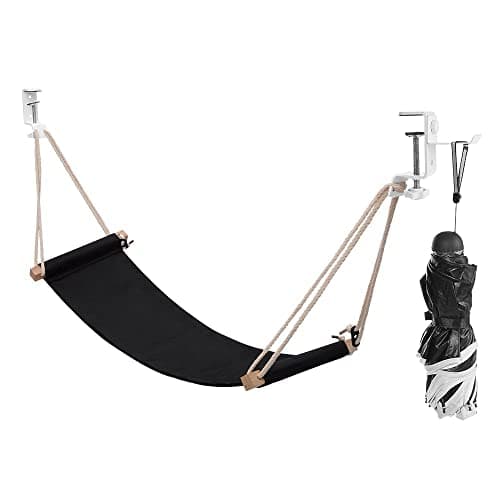
iMissiu Foot Hammock Under-Desk Footrest

A sling that straps to the desk rather than a platform on the floor. It is not an ergonomic fix, it is a comfort accessory - but it costs almost nothing, packs flat, and is the only option here for a hot-desk or a travel bag.

Most portable
7.7
$16.98Amazon

#ad · Live prices from the Amazon Product API, as of Sep 6, 2026. Where we have no verified live price we show none — we would rather leave a gap than print a number that has rotted.

In detail

The picks, in full

01
Humanscale Humanscale FM300 Foot Machine Footrest

Best overall

Humanscale FM300 Foot Machine Footrest

Dimensions
11.875" D x 16" W
Height range
3.75" to 6.75"
Movement
Ball-bearing rollers allow gentle rocking
Platform
Solid hardwood with a non-skid surface
Frame
Steel frame with phenolic side supports
8.6/10

The one that lets your feet keep moving. A hardwood platform on ball-bearing rollers rocks like a rocking chair does, which is the point - a static footrest supports your legs, this one also keeps the calf muscles working.

Height Range
8.8
Movement
9.6
Build
9.6
Value
6.4

Pros

  • A three-inch height range covers most of the gap a too-tall desk creates
  • Rocking motion keeps lower-leg muscles active, which is what static footrests do not do
  • Solid hardwood and steel rather than the molded plastic most footrests use
  • Side knobs set the height firmly and hold it, with no ratchet to slip

Cons

  • By a wide margin the most expensive footrest here
  • 16 inches wide is narrower than the flat-platform picks, so there is less room to spread your feet
  • The rocking action is not what you want if you need a fixed, planted platform

Skip this if…

you want a completely still platform to brace against while typing

$119.00View on Amazon

$130.008% off

Price as of Sep 6, 2026. Prices change — Amazon's is the one that counts.

#ad · we may earn a commission from this link to Humanscale FM300 Foot Machine Footrest

02
StarTech.com StarTech Under Desk Foot Rest (FTRST1)

Best value

StarTech Under Desk Foot Rest (FTRST1)

Dimensions
18" x 14" (45 x 35cm)
Height range
3.7" to 4.8"
Tilt
Two ranges: 0 to 15 degrees and 0 to 30 degrees
Surface
Rubberized, non-slip, with massage bumps
Warranty
5-year StarTech warranty
8.6/10

The best combination of size, angle adjustment, and price. An 18 by 14-inch platform is genuinely large, and two tilt ranges mean you can set the ankle angle rather than accept one.

Height Range
7.6
Movement
8.8
Build
8.8
Value
9

Pros

  • 18 by 14 inches is the largest platform here, which matters if you shift your feet around
  • Two selectable tilt ranges cover both a slight angle and a pronounced one
  • Rocking design lets you flex your ankles rather than holding one position
  • A five-year warranty on a footrest is unusual and says something about the build

Cons

  • A 1.1-inch height range is narrower than the Humanscale's three inches
  • Massage bumps are divisive - some people find them irritating in bare feet
  • Heavier than the foam picks and less easy to move between desks

Skip this if…

your desk-to-floor gap needs more than about five inches of lift

$46.24View on Amazon

$55.9917% off

Price as of Sep 6, 2026. Prices change — Amazon's is the one that counts.

#ad · we may earn a commission from this link to StarTech Under Desk Foot Rest (FTRST1)

03
CasaZenith CasaZenith Six-Height Adjustable Foot Rest

Most height settings for the money

CasaZenith Six-Height Adjustable Foot Rest

Height
Six adjustable height positions
Type
Adjustable platform footrest
Use
Under-desk foot support at a set height
Adjustment
Set by hand, no tools
7.9/10

Six discrete height settings for the price of a takeaway. If your problem is specifically that the desk is too tall and you need to find the right lift by trial and error, this is the cheapest way to do it.

Height Range
9
Movement
6.4
Build
6.8
Value
9.4

Pros

  • Six settings means you can actually find your height rather than accept a fixed one
  • The cheapest way to test whether foot support is what your setup was missing
  • Light enough to move between a desk and a dining table

Cons

  • Plastic construction, and it feels like it next to the Humanscale or StarTech
  • Discrete steps rather than continuous adjustment
  • No rocking movement - it is a static platform

Skip this if…

you want something that will still be in use in five years

$19.99View on Amazon

Price as of Sep 6, 2026. Prices change — Amazon's is the one that counts.

#ad · we may earn a commission from this link to CasaZenith Six-Height Adjustable Foot Rest

04
Everlasting Comfort Everlasting Comfort Memory Foam Under-Desk Foot Rest

Best for leg fatigue

Everlasting Comfort Memory Foam Under-Desk Foot Rest

Material
Memory foam
Type
Fixed-height foam foot rest and leg elevation pillow
Height
Fixed by the foam wedge shape
Cover
Removable cover
7.2/10

A foam wedge rather than an adjustable platform, and the right answer if the problem is pressure and leg fatigue rather than a desk that is too tall. It elevates and cushions; it does not adjust.

Height Range
6.2
Movement
6
Build
8
Value
8.6

Pros

  • Memory foam spreads pressure across the whole foot instead of a hard platform edge
  • Doubles as a leg elevation pillow away from the desk
  • Silent and completely static - nothing to slip or rattle
  • The most comfortable option here for someone in socks or bare feet

Cons

  • Fixed height, so it cannot be tuned to your desk-to-floor gap
  • Foam compresses under load, so the effective lift is less than the measured height
  • No tilt, so it cannot set the ankle angle

Skip this if…

your actual problem is a desk that is too tall - you need a measured lift, not a cushion

$23.99View on Amazon

$39.9940% off

Price as of Sep 6, 2026. Prices change — Amazon's is the one that counts.

#ad · we may earn a commission from this link to Everlasting Comfort Memory Foam Under-Desk Foot Rest

05
iMissiu iMissiu Foot Hammock Under-Desk Footrest

Most portable

iMissiu Foot Hammock Under-Desk Footrest

Type
Adjustable hammock sling
Mounting
Straps to the desk, no floor contact
Adjustment
Adjustable strap length
Extra
Integrated headphone holder
Packed size
Folds flat, portable
7.7/10

A sling that straps to the desk rather than a platform on the floor. It is not an ergonomic fix, it is a comfort accessory - but it costs almost nothing, packs flat, and is the only option here for a hot-desk or a travel bag.

Height Range
8
Movement
7
Build
6.6
Value
9

Pros

  • Packs into a bag, which no platform footrest does
  • Adjustable straps set the height across a wide range
  • Costs less than anything else here by a clear margin

Cons

  • A sling does not support the feet the way a firm platform does, so it is comfort rather than ergonomics
  • Needs a desk with a suitable frame or edge to strap to
  • Encourages a reclined, legs-up posture that is not a working posture

Skip this if…

you are trying to correct a genuine seated posture problem - buy a platform instead

$16.98View on Amazon

Price as of Sep 6, 2026. Prices change — Amazon's is the one that counts.

#ad · we may earn a commission from this link to iMissiu Foot Hammock Under-Desk Footrest

How to choose an under-desk footrest

Measure the gap first, then match it to a height range with room to spare at both ends — a footrest set at the very top of its range is usually the least stable. Then decide whether you want tilt: if your ankles ache or your calves feel tight by the afternoon, yes. Then decide static or moving: a rocking platform keeps circulation up, a fixed one gives you something to brace against.

Check the platform size against the space you actually have. Eighteen inches wide is generous and comfortable, but it needs a clear stretch of floor under the desk, and a drawer pedestal, a desktop tower, or a cable tray support may already have claimed it. Finally, check the surface: a non-slip or rubberized top matters more than it sounds, because a footrest that slides forward when you push against it is worse than none.

Set the height once the chair is already correct, not before. The order is desk height, then chair height from your elbows, then footrest to close whatever gap is left — doing it in any other order means solving for the wrong number. The full sequence is in how to adjust an office chair.
How we picked

We do not run a testing lab

We compiled the published manufacturer specifications, did the ergonomics, VESA and desk-depth math ourselves, and read aggregated owner reviews, then scored each product against a published rubric. The scores are judgments from documented research — they are not measurements we took, because we do not have a lab and we are not going to pretend we do. Every spec traces back to a listing or manual named in Sources.

Questions

Frequently asked

Do I actually need a footrest?
Only if raising your chair to the correct height for your desk leaves your feet off the floor, or your thighs pressed against the front edge of the seat. Sit as you normally work with your elbows near 90 degrees; if your feet are flat on the floor, you do not need one. If they dangle or your toes are reaching, you do.
What height should a footrest be?
Whatever closes the gap between your feet and the floor when the chair is set correctly for your desk — usually two to six inches. Measure it rather than guessing, and buy a footrest whose range covers your number with a little room on either side rather than one that only just reaches it.
Is a tilted footrest better than a flat one?
Generally yes. A tilt of roughly 10 to 30 degrees puts the ankle in a more neutral position and lets the calf lengthen, rather than holding a single fixed angle all day. A flat platform is fine if you mainly want something firm to brace against while typing.
Can I just use a box or a stack of books?
For a small gap, yes — it is a legitimate way to test whether foot support is what your setup was missing before spending anything. What you give up is height adjustment, a tilt angle, a non-slip surface, and any movement. If the improvised version helps, that is your evidence that a real one is worth buying.
Footrest or a lower desk?
A lower desk, every time, if you can change it. A footrest is a workaround for a fixed desk that is too tall for you. If you have a height-adjustable desk, lower it until your feet reach the floor and your elbows sit near 90 degrees — see how high should your desk be.

Keep reading

Receipts

Sources

We do not run a testing lab, and we do not pretend to. Specifications come from the manufacturer or retailer listing; the footprint and clearance math is ours and reproducible. Where we could not verify a number, we say so on the page rather than quietly leaving it out. Read our full method.