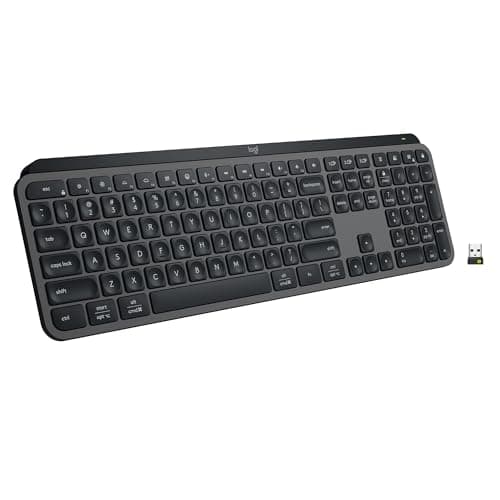
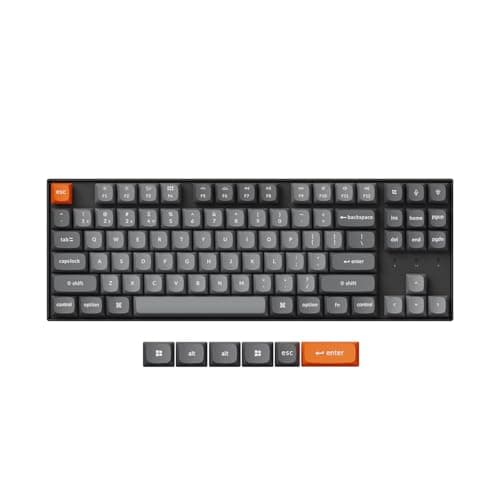
If you work alone in a room, buy mechanical. If you share a room, take calls on an open mic, or type next to someone else, buy either a membrane board or a mechanical with quiet switches. That is the practical answer, and it turns on noise rather than on feel — because feel is a preference and noise is other people’s problem.
The comparison, on what actually differs
| | Mechanical | Membrane / scissor |
|---|
| How a keypress registers | Individual switch per key, spring and stem | Rubber dome or scissor collapsing onto a contact sheet |
| Rated switch life | Typically 50–100 million presses | Typically 5–10 million presses |
| Repairable | Yes — a single switch can be replaced | No — the contact sheet is the keyboard |
| Noise | Audible; clicky switches are loud | Quiet by construction |
| Height | Tall unless low-profile | Low — laptop-like |
| Feel is chosen by | You, via switch type | The manufacturer |
| Typical price | Higher | Lower |
What is actually different inside
A membrane keyboard has one continuous sheet of contacts under all the keys. Pressing a key collapses a rubber dome (or a scissor mechanism over a dome) which bridges two contacts on that sheet. It is cheap, quiet, low and reliable — and it is one part, which means it cannot be repaired. When one key stops registering, the sheet has failed and the keyboard is finished.
A mechanical keyboard has an independent switch under every key: a housing, a spring and a stem that moves a metal contact. Each switch is a discrete component rated for tens of millions of presses, and on a hot-swappable board it can be pulled out with a five-dollar tool and replaced. That is the durability argument, and it is real.
The noise problem, stated honestly
Mechanical keyboards are louder. All of them, including the ones sold as quiet. The differences within the category are large — a clicky switch is dramatically louder than a silenced linear one — but the quietest mechanical is still noisier than an ordinary scissor keyboard.
This matters more than typing feel because it is the only property of your keyboard that other people experience. On an open microphone during a call, keystrokes come through clearly, and on a shared desk they are the thing colleagues remember. If either applies, that constraint decides the purchase and the rest of this page is commentary.
The mitigations, in order of effect: choose a linear or silent switch rather than tactile or clicky; add a foam or o-ring dampening kit; put the keyboard on a desk mat rather than a bare hard surface, which removes a surprising amount of the resonance. What each switch type sounds like is in keyboard switches explained.
Height matters more than the debate admits
A full-height mechanical keyboard is tall, and height sets wrist extension. A scissor keyboard is about as flat as a laptop, which is why many people find them more comfortable without ever thinking about why.
Low-profile mechanical switches close most of that gap, and they are the reason the third pick on this page exists. If your wrists are the actual complaint rather than the typing feel, height and angle are the levers to pull — either a low-profile board, or a full-height one paired with a wrist rest. The mechanism is in keyboard and mouse ergonomics.
Cost over ten years
A good membrane keyboard lasts several years and then goes in the bin. A hot-swappable mechanical outlives several switch sets and several keycap sets, and the parts are cheap relative to the board. Over a decade the mechanical is usually the cheaper option, and it is certainly the less wasteful one.
The caveat is that mechanical keyboards invite spending. Keycap sets, switches, dampening foam and coiled cables are all real purchases people make, and none of them makes you type faster. If you want the durability without the hobby, buy one good board with the switches you want and stop.
In a shared room this choice is usually settled by noise rather than by feel. The quiet keyboard roundup ranks both mechanisms on exactly that.
The verdict
Buy mechanicalif you work in a room of your own, you type for hours, and you want a keyboard that can be repaired rather than replaced. Buy a hot-swappable one even if you have no intention of changing switches — it is what turns a wrong choice into a ten-minute fix. The field is in best mechanical keyboards for the office, and the smaller layouts are in the compact keyboard roundup.
Buy membrane if you share a room, spend your day on calls, want the flattest possible board, or simply do not care what a keyboard feels like as long as it works. A good scissor keyboard is a genuinely nice object and considerably cheaper; it just cannot be fixed.
Buy low-profile mechanical if you want the feedback and the durability but the noise or the height is the obstacle. It is the honest middle of this argument rather than a fudge, and for a lot of desks it is the right answer.
If the reason you are shopping is wrist or forearm pain rather than preference, neither category is the fix. The mechanism that helps is changing the angle your hands sit at, which means a split or tented ergonomic board — both of which come in mechanical and membrane versions.