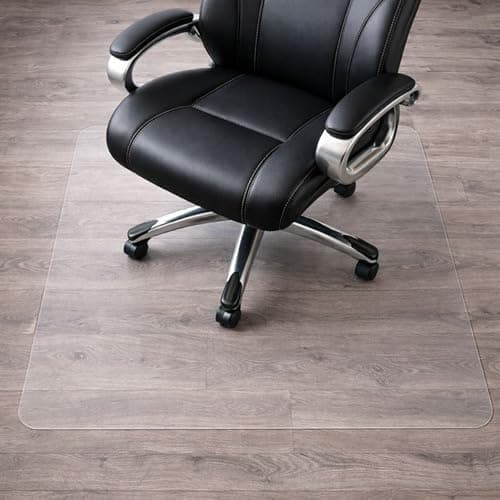
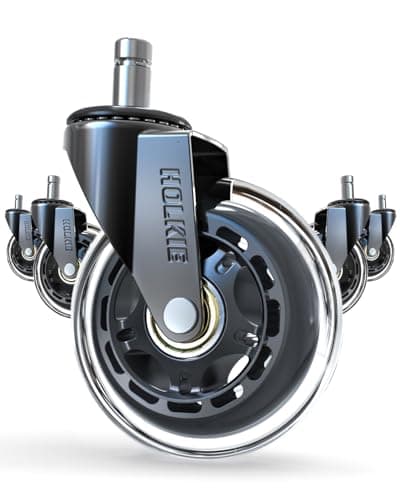
Yes, a normal office chair can mark a hardwood or vinyl floor, and there are exactly two fixes worth your money. Swap the wheels for soft polyurethane, rollerblade-style casters, which is cheap, invisible and also makes the chair roll better. Or put a hard floor mat with a smooth underside under the chair, which protects a defined area completely.
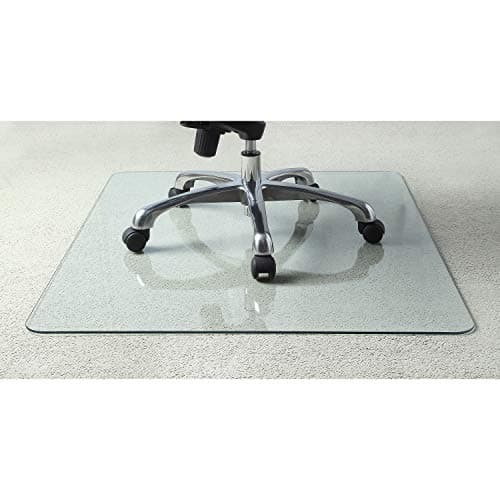
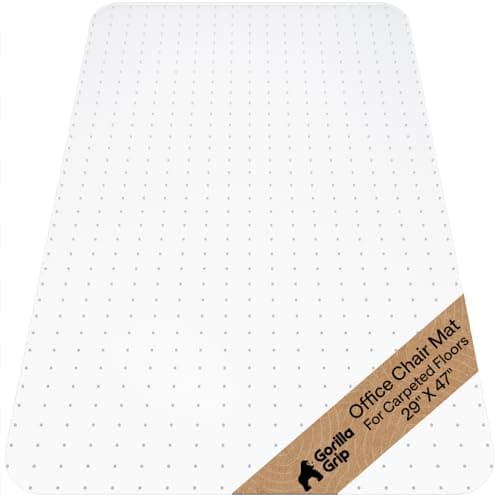
And one thing not to do, because it is the most common mistake on this subject: do not put a carpet chair mat on a hard floor.Carpet mats have studs or spikes moulded into the underside to stop them sliding on pile. On wood, laminate or vinyl those spikes are dozens of hard points under your body weight, dragged slightly every time the mat shifts. The Gorilla Grip carpet mat below states a “studded and spiked” underside; the Marvelux hard floor mat states a smooth one. That line in the specification is the whole decision.
What actually damages the floor
Hardness. Stock casters are usually hard nylon, chosen because a hard wheel rolls best on carpet. Nylon is harder than a wood floor finish, so it burnishes and eventually scratches it. A polyurethane-tyred caster is softer than the finish, which is the direction you want.
Grit. A wheel picks up sand and grit and holds it in the tread. The caster then works as a very slow sanding belt. This is why floors under chairs look dull in a traffic pattern rather than scratched in one place, and it is also why wiping the wheels occasionally genuinely helps.
Point load. Your weight plus the chair divided by five small contact patches is a lot of pressure per square inch. On softer species and on vinyl with a thin wear layer, that is enough to dent, especially where the chair sits parked for hours. The Lorell glass mat below publishes a 1,000 lb load rating precisely because spreading that load is the point of a mat.
Skidding. Not damage, but the other half of the complaint: hard wheels skate on a smooth floor, so the chair slides away as you sit down. Soft casters grip, and most of them are designed to stay put under load and roll when pushed.
Fix 1: change the casters
A caster swap is the cheapest real upgrade an existing chair can take, and it takes about two minutes — the wheels are a friction fit in the base and pull straight out. Soft polyurethane wheels roll on both hard floors and low-pile carpet, so you do not have to choose.
The one catch, and it is the same one as with gas cylinders: chair stems are not standardized. Pull one existing caster out and measure the stem diameter and length before ordering. A grip-ring stem that is nominally close but not right either falls out or will not seat. Our chair cylinder guide covers the same measuring discipline for the other replaceable part.
Also check the wheel diameter against your chair. A larger wheel rolls over thresholds and cable runs more easily, but it raises the seat slightly — worth knowing if you are already at the bottom of your height range. The height arithmetic is in the chair sizing guide.
Fix 2: put a mat down
A mat is the better answer when the floor is a rental, is expensive, or has a thin wear layer, because it protects the whole working area rather than making the chair gentler. Three things to check on the listing:
- A smooth underside, stated explicitly.If the listing mentions studs, spikes, cleats or “grips carpet”, it is a carpet mat.
- Material. Polycarbonate stays clear and does not crack in the cold the way cheap PVC can. Tempered glass is the premium option and is effectively permanent. Vinyl is the budget option and is the one most likely to curl.
- Size against your actual rolling area. Measure the arc your chair travels, not the desk. Most people buy a mat one size too small and then roll off the edge all day, which is both annoying and a trip hazard.
The full ranking, carpet mats included, is in the chair mat roundup.
What about an area rug?
It protects the floor and it is the worst rolling surface of the lot. A rug under a rolling chair bunches, rucks at the edges and catches casters, and a chair that is hard to move is a chair you shuffle instead of roll — which is how you end up dragging it across the exposed floor beyond the rug. If you want the look, put a hard floor mat on top of the rug in the rolling zone, or use a low-pile rug and soft casters.
Which fix for which floor
| Floor | First move | Why |
|---|
| Solid hardwood, site-finished | Soft casters, then a mat if it is a rental | The finish scratches before the wood dents |
| Engineered wood or laminate | Hard floor mat with a smooth back | A thin wear layer does not forgive grit |
| Luxury vinyl plank | Hard floor mat; check the mat is not vinyl-on-vinyl | Vinyl can dent under a parked chair and stain under some plasticizers |
| Tile | Soft casters | Tile does not scratch easily, but hard wheels are noisy and skid |
| Low-pile carpet | Carpet mat with spikes, or larger hard wheels | Here the spikes are the feature, not the hazard |