Most chair reviews are written for someone about five foot nine and one hundred and seventy pounds, because that is who the standard chair is designed around. If you are outside that, the usual advice stops working: the chair that everyone calls comfortable will have a seat too shallow, a back that ends between your shoulder blades, and a gas lift that tops out two inches below where your knees want to be.
Four published numbers decide fit. Take these measurements before you shop — they take five minutes and they narrow the field faster than any review can.
1. Weight rating. The one everybody looks at, and the one with the most margin baked in. Ratings here run from 275 to 450 lb. Aim for a chair rated comfortably above your weight rather than close to it: cylinder and base failures cluster near the limit, and a chair working at 60% of its rating simply lasts longer. A rating of 400 lb or more usually also means a reinforced base and a heavier-duty gas cylinder, which are the parts that actually fail.
2. Seat height range.The most-ignored spec and the one that ruins the most purchases. Your seat height should let your feet sit flat with thighs roughly parallel to the floor — for someone six foot two that is often 20 to 22 inches, and a great many chairs top out at 20. Published ranges here go up to 22.25 inches. If a listing does not state the range, that is a reason to be suspicious, not a detail to overlook.
3. Seat depth. Taller people have longer femurs, and a seat that is too short leaves the thighs unsupported past the front edge; one that is too long presses into the back of the knee when you sit fully back. A seat around 18.5 to 20 inches deep suits most tall sitters, and a chair with a sliding seat pan solves it outright by letting you set the depth rather than accept it.
4. Back height. A backrest that ends below the shoulder blades gives a tall sitter no upper-back support at all. Back heights of 28 inches and up, or a genuinely adjustable headrest, are what to look for.
One note on how these numbers combine. Raising the seat to fit your legs often lifts your elbows above the desk, and the correct fix is to raise the desk rather than lower the chair — the order for that is in our desk height guide. If the desk cannot go higher, a height-adjustable frameis the more honest answer than sitting badly — and standing desks for tall people ranks those frames on the one number that matters here, which is how high they actually go. While you are measuring, note that chairs in this tier have very different service lives: how long an office chair lasts sets the published warranties against what actually wears out.
Height and load are different specifications, and plenty of people need both — the weight capacity guide compares the published ratings here against the seat widths that go with them.
The short answer
Quick picks
#ad · Live prices from the Amazon Product API, as of October 23, 2026. Where we have no verified live price we show none — we would rather leave a gap than print a number that has rotted.
In detail
The picks, in full
Best overall
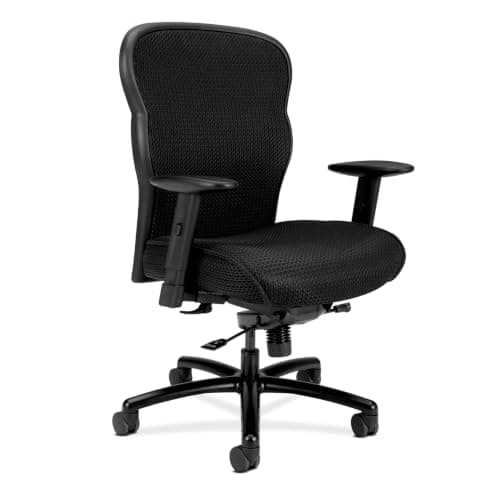
HON Wave Big and Tall Mesh Executive Chair
- Weight capacity
- 450 lb
- Seat height
- 19.25" to 22.25"
- Seat size
- 21.63" wide x 18.75" deep
- Overall size
- 29.5" W x 25.6" D x 41.5" H
- Back and seat
- Mesh, with integrated lumbar support
- Mechanism
- Mid-range knee-tilt with pneumatic height
- Armrests
- Height and width adjustable
The only chair here that publishes every number a tall sitter needs and passes all of them: 450 lb rated, a 19.25 to 22.25 inch seat height range, and a 21.6 by 18.75 inch seat.
- Capacity
- 9.8
- Seat Height Range
- 9.4
- Seat Fit
- 8.8
- Value
- 7.4
Pros
- +450 lb is the highest published rating on this list
- +22.25 inches at the top of the seat range fits sitters over six foot two, which most chairs do not
- +Width-adjustable arms matter for broader sitters as much as height-adjustable ones do
- +Mesh seat and back keeps a heavier sitter cooler than bonded leather
- +Knee-tilt pivots near the front of the seat, so your feet stay down when you recline
Cons
- −Costs three times the budget picks here
- −Fixed seat depth - 18.75 inches is generous but not adjustable
- −Commercial-office looks rather than anything designed
Skip this if…
…you want a headrest - this chair does not have one.
Best premium
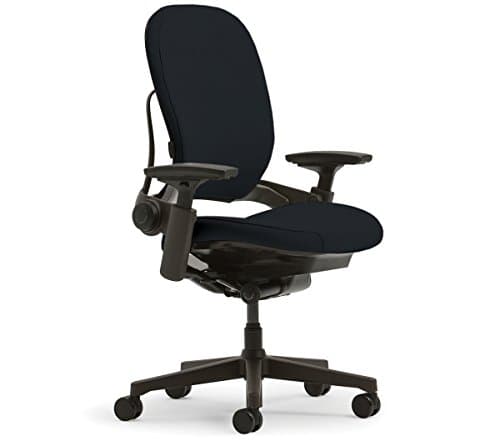
Steelcase Leap V2 Chair
- Weight capacity
- 400 lb
- Seat depth
- Adjustable seat depth
- Back
- LiveBack, changes shape as you move
- Lumbar
- Adjustable lumbar height and firmness
- Recline
- Natural Glide system, 5-position tilt with tension control
- Armrests
- Fully adjustable 4D arms
- Warranty
- 12 years, covering the entire chair
The premium answer, and the one with adjustable seat depth - the single adjustment that matters most for long femurs. 400 lb rated with a 12-year warranty behind it.
- Capacity
- 9
- Seat Height Range
- 8.4
- Seat Fit
- 9.6
- Value
- 6.6
Pros
- +Adjustable seat depth is the tall sitter's most valuable adjustment and almost nothing at this weight rating has it
- +Lumbar height and firmness are separately adjustable, so the support lands where your curve actually is
- +Natural Glide slides the seat forward as you recline, so you stay in reach of the keyboard
- +12-year whole-chair warranty is the longest here
Cons
- −By far the most expensive chair on this list
- −No headrest in the standard configuration
- −Frequently sold through resellers, so condition and configuration vary
Skip this if…
…you are heavy rather than tall - the HON's 450 lb rating has more margin.
Best mid-range
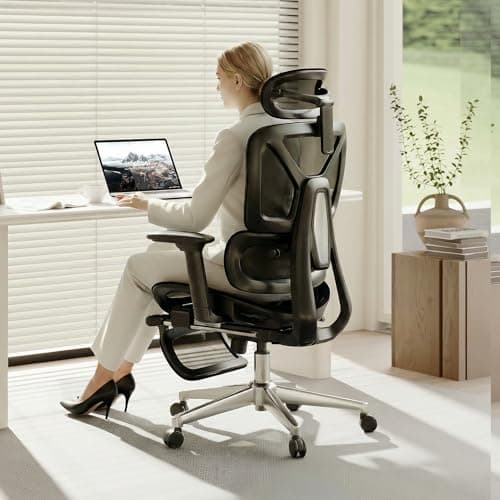
FlexiSpot ErgoX Ergonomic Office Chair
- Weight capacity
- Up to 400 lb
- Seat & back
- AeroWeave air-mesh, breathable
- Lumbar
- Dynamic lumbar with a 5-level adjustable back
- Armrests
- 3D adjustable armrests
- Extras
- 3D headrest and a retractable footrest
The mid-range chair with a genuinely big-and-tall weight rating. 400 lb, an air-mesh seat and back, a 3D headrest and a retractable footrest, at a fraction of the premium price.
- Capacity
- 9.2
- Seat Height Range
- 7.6
- Seat Fit
- 8.2
- Value
- 8.8
Pros
- +400 lb rating at a mid-market price, which is unusual
- +Mesh seat as well as back, which heavier sitters notice on warm days
- +3D headrest gives upper-body support that most tall sitters are missing
- +Retractable footrest turns the chair into a genuine break position
Cons
- −Seat height range is not published as clearly as the HON's
- −Build quality is a step below the 12-year-warranty chairs
- −The footrest is a novelty for some and the reason to buy for others
Skip this if…
…you are over about six foot three - confirm the seat height range before ordering.
Best padded
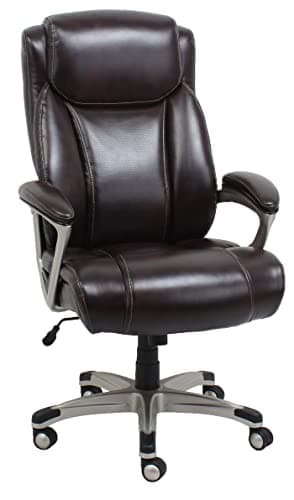
Serta Big and Tall Executive Office Chair
- Weight capacity
- 350 lb
- Seat width
- 22.5"
- Backrest height
- 28.5", contoured
- Upholstery
- Bonded leather
- Extras
- Cushioned headrest, padded armrests, body pillows
- Base
- Metal base, 360 degree swivel, carpet casters
The padded option. A 22.5-inch seat and a 28.5-inch backrest in bonded leather, rated to 350 lb - the chair for someone who finds mesh too firm and wants width.
- Capacity
- 8.4
- Seat Height Range
- 7.4
- Seat Fit
- 8.8
- Value
- 8.8
Pros
- +22.5 inches of seat width is the broadest here, which matters more than capacity for some sitters
- +28.5-inch backrest reaches the upper back on a tall frame, plus a headrest above that
- +Deep padding suits sitters who find mesh seats hard
- +Cheapest chair here with a genuine big-and-tall rating
Cons
- −Bonded leather traps heat, which is the trade for the padding
- −350 lb rating rather than 400 or 450
- −Executive-recliner adjustability - fewer axes than the task chairs here
- −Casters are specified for carpet, so a hard floor wants a swap or a mat
Skip this if…
…you run hot - a padded leather chair is the wrong direction entirely.
Best budget
Amazon Basics Big and Tall Executive Office Chair
- Weight capacity
- 350 lb
- Dimensions
- 28.5" D x 30.25" W x 47.9" H
- Adjustment
- Pneumatic height, 360 degree swivel
- Support
- Lumbar support built into the backrest
- Finish
- Brown upholstery with a pewter base
The budget entry into the category, and it publishes its dimensions, which many cheap chairs do not. 350 lb rated on a 30.25-inch-wide frame.
- Capacity
- 8.4
- Seat Height Range
- 7
- Seat Fit
- 7.8
- Value
- 9.4
Pros
- +350 lb rating at the lowest price on this list
- +Full external dimensions published, so you can check it against the room
- +47.9-inch overall height means a genuinely tall back
- +Straightforward returns, which matters when fit is the whole question
Cons
- −Fewest adjustments here - height and tilt, and not much else
- −No adjustable lumbar, so the built-in curve either fits you or it does not
- −Executive styling rather than task-chair ergonomics
Skip this if…
…you sit for eight hours - this is a chair for a desk you use, not a desk you live at.
Take these four measurements first
Seat height.Sit on a hard chair with your feet flat and your thighs level. Measure from the floor to the top of the seat surface. That is the number your chair’s range has to include — not reach, include, because you want it in the middle of the range rather than at the top of the gas lift.
Seat depth. Sit back against the backrest and measure from the back of your seat to about two fingers behind your knee. That is your usable seat depth. Chairs with a sliding seat pan can be set to it; chairs without one need to be within about an inch.
Seat width. Measure across your hips while seated and add about two inches of clearance. Width matters independently of weight, which is why the widest seat here is not on the highest-rated chair.
Back height. Measure from the seat surface to the top of your shoulders. If the backrest is shorter than that, your upper back is unsupported, and a headrest that only reaches the base of your skull when reclined does not fix it.
Capacity ratings are about the parts you cannot see
A weight rating is mostly a statement about the gas cylinder and the base. Big-and-tall chairs use a Class 4 cylinder and a reinforced base, usually steel or heavy-duty nylon, with five casters rated accordingly. That is why a 450 lb chair costs meaningfully more than a 275 lb one that looks the same in photographs — the difference is inside the column.
The armrest problem nobody mentions
Broader sitters need arms that move outward, not just up and down. Arms fixed at a standard width press into the ribs, and the usual response is to leave the elbows unsupported entirely, which is what the arms were there to prevent. Width-adjustable or pivoting arms are the specification to look for; the fitting method is in keyboard and mouse ergonomics, since arm height and keyboard height are one problem.
If you are tall but not heavy
Do not default to a big-and-tall chair. Those chairs solve width and capacity, which you may not need, and they often have fewer adjustments than a good task chair. If your issue is leg length and back height rather than weight, a task chair with adjustable seat depth and a tall back — or a headrest — will fit you better. The wider field is in the ergonomic office chair roundup and best office chairs for long hours.
Then set it up properly
A correctly sized chair adjusted badly is still a bad chair, and the order in which you set the adjustments changes the result — seat height first, then everything else relative to it. That order is in how to adjust an office chair. If raising the seat to fit your legs puts your elbows above the desk, the desk is the thing that needs to change.
Those four measurements apply at the other end of the range too, and the chairs that publish their seat height and seat depth are the only ones you can check them against on paper. The worked version, with the published dimensions for three very differently sized chairs, is in what size office chair do you need.
Essentials
The small parts that finish the job
Nothing here changes a pick above, and none of it is a considered purchase. These are the cheap pieces that decide whether the expensive one works properly, and the ones people discover they are missing on the day the big box arrives.
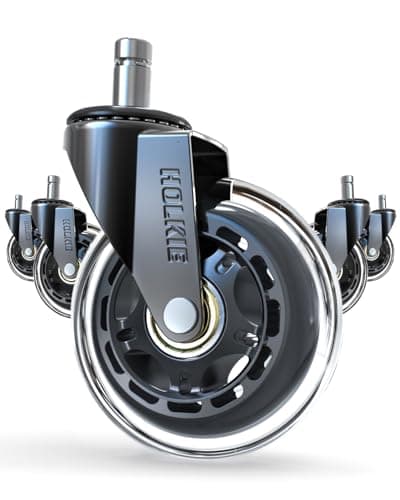
HOLKIE Rollerblade-Style Chair Casters, 3 in (set of 5)
The cheapest real upgrade a chair you already own can take. Hard nylon wheels fight carpet and skate on hard floors; wider rubber casters roll on both and stay put when you sit down.
Check first: chair stems are not standardized. Pull one existing caster out and measure its stem diameter and length against the listing before ordering.
#ad · Live prices from the Amazon Product API, as of October 23, 2026. Where we have no verified live price we show none. We may earn a commission, at no extra cost to you.
How we picked
We do not run a testing lab
We compiled the published manufacturer specifications, did the ergonomics, VESA and desk-depth math ourselves, and read aggregated owner reviews, then scored each product against a published rubric. The scores are judgments from documented research — they are not measurements we took, because we do not have a lab and we are not going to pretend we do. Every spec traces back to a listing or manual named in Sources.
Questions
Frequently asked
What weight capacity office chair do I need?+
Choose a rating comfortably above your weight rather than close to it — roughly 25% of headroom is a sensible target. The rating is mostly a statement about the gas cylinder and base, and those are the parts that fail when a chair is run near its limit. Ratings on this list run from 350 to 450 lb.
What is the best seat height for a tall person?+
Whatever lets your feet sit flat with thighs roughly parallel to the floor. For someone around six foot two that is often 20 to 22 inches, and many standard chairs stop at 20. Check the published seat height range rather than the chair’s overall height, and aim to sit in the middle of it.
Are big and tall chairs better for tall people?+
Not automatically. They solve seat width and weight capacity, and often have fewer adjustments than a comparable task chair. If your issue is leg length and back height rather than weight, a task chair with adjustable seat depth and a tall back is usually the better fit.
Does seat depth matter more if you are tall?+
Yes, because seat depth tracks femur length. Too shallow and your thighs hang unsupported past the edge; too deep and the seat front presses behind your knees when you sit fully back. A sliding seat pan removes the problem; without one, get within about an inch of your measured depth.
Will a taller chair mean I need a taller desk?+
Often, yes. If raising the seat to fit your legs puts your elbows above the desk surface, the desk is now too low, and lowering the chair to compensate just moves the problem to your knees. Raise the desk instead — see
how high should your desk be.
Receipts
Sources
We do not run a testing lab, and we do not pretend to. Specifications come from the manufacturer or retailer listing; the footprint and clearance math is ours and reproducible. Where we could not verify a number, we say so on the page rather than quietly leaving it out. Read our full method.