If you only take one thing from this page: measure the height from the floor to the back of your knee while you are sitting, and refuse to buy any chair whose published seat height range does not cover that number. That single check eliminates more bad purchases than every review you will read, and the chair whose sizing is published most honestly — the Herman Miller Aeron, in three frames with three different seat depths — is the first pick below for exactly that reason.
Chairs are sold as though one size fits everyone between 5 ft 2 in and 6 ft 4 in. A few genuinely adjust that far. Most do not, and the mismatch shows up as symptoms people blame on the chair being “uncomfortable”: dangling feet, numb thighs, a backrest that pushes between the shoulder blades instead of into the lower back. Here are the four measurements, in the order they matter, and how to read them against a spec sheet.
1. Seat height: floor to the back of your knee
Sit on a hard chair with your feet flat and your shins vertical. Measure from the floor to the crease behind your knee. That is your popliteal height, and it is the number a seat height range has to contain — add about an inch if you work in shoes.
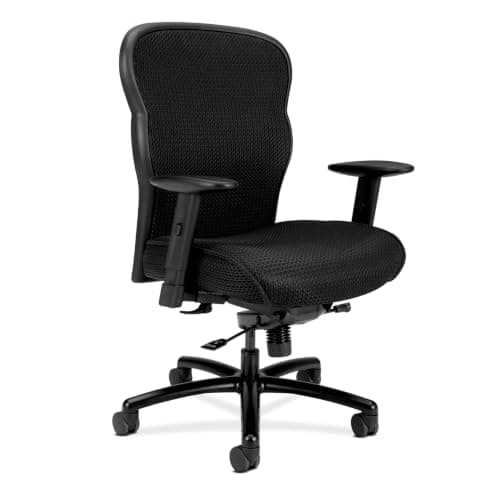
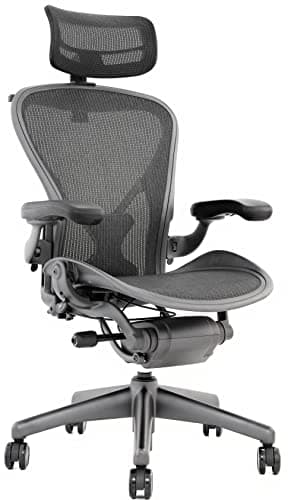
Now read the spec sheet. Herman Miller publishes the Aeron as 14.4 to 19.3 in in size A, 14.8 to 22.8 in in size B and 15.8 to 22.8 in in size C. The HON Wave, a big-and-tall chair, starts at 19.25 in and tops out at 22.25 in. Those two ranges barely overlap. A 16 in popliteal height — common for adults around 5 ft 3 in — cannot be served by the Wave at all, however good the chair is, because its lowest setting is three inches too high.
If a chair is above your range, your feet lose the floor and your thighs take the load. A footrest is a legitimate fix for a one-off gap — see the footrest roundup— but do not buy a chair that needs a footrest to be usable if a correctly sized chair exists.
2. Seat depth: hip to the back of your knee
Still sitting, measure from the back of your hip to the crease behind your knee. That is your buttock-popliteal length. Your seat pan wants to be roughly one to three inches shorter than that number, so there is a two- to three-finger gap between the front edge of the seat and the back of your calf.
Get this wrong and you feel it within an hour. Too deep and the front edge presses the back of your knee, which is the sensation people describe as their legs going numb. Too shallow and your thighs carry no weight at all, so it all lands on your sit bones.
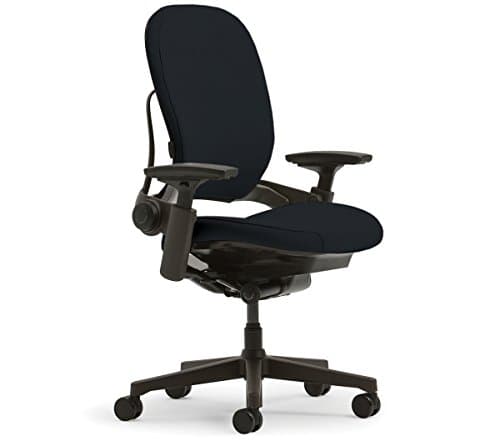
This is where sized and adjustable chairs part company. The Aeron fixes seat depth at purchase: 16 in on size A, 17 in on size B, 18.5 in on size C. The Steelcase Leap has an adjustable seat depth you slide, which is the safer choice if your measurement falls between Aeron frames — our Aeron vs Leap V2 comparison is entirely about that trade. The HON Wave publishes an 18.75 in seat depth, which is deep: fine for long thighs, wrong for short ones.
3. Seat width: hips plus clearance
Measure your hips at their widest while seated and add an inch or two. Most office chairs land between 19 and 21 in of seat width, so this measurement rarely rules anything out — but it decides whether fixed armrests will pinch. The HON Wave publishes 21.63 in of seat width, the widest of the three chairs below, which is the point of a big-and-tall chair.
Armrests matter more than width here. Width-adjustable arms, which the Wave and the Leap both have, let you set the arms outside your hips. Fixed arms do not, and on a narrow chair they become the limiting dimension.
4. Back height and armrest height
A backrest supports you properly when its lumbar curve lands in the small of your back, roughly at belt height. Height-adjustable lumbar support — present on the Leap, the Aeron (as PostureFit SL) and the Series 2 — moves the support rather than making you move to it, and it is the single most useful adjustment on any chair.
For armrests, sit with your shoulders relaxed and your elbows at roughly 90 degrees, then measure from the seat surface to the underside of your elbow. You want an arm that reaches that height, and that then gets out of the way of the desk. The Wave publishes 41.5 in of overall height and 29.5 in of width, which is also worth checking against the space under your desk before you order anything with a tall back.
Then check capacity, honestly
Weight capacity is a structural rating, not a comfort rating, and it is the one spec where sitting near the limit is a bad idea all day long. The HON Wave is rated to 450 lb, the Steelcase Leap to 400 lb with a Leap Plus variant to 500 lb, and the Series 2 to 400 lb. Herman Miller does not publish a per-size weight capacity for the Aeron on its specification page, and we are not going to invent one — ask the seller if that number decides your purchase. There is a fuller ranking in our chairs for tall and heavy users roundup.
The four measurements against three chairs
| Published spec | Aeron (A / B / C) | Leap V2 | HON Wave |
|---|
| Seat height | 14.4-19.3 / 14.8-22.8 / 15.8-22.8 in | Not published | 19.25-22.25 in |
| Seat depth | 16 / 17 / 18.5 in (fixed) | Adjustable | 18.75 in (fixed) |
| Seat width | 27.5 / 28.3 / 28.3 in overall width | Not published | 21.63 in seat width |
| Lumbar | PostureFit SL, adjustable | Adjustable height and firmness | Integrated |
| Capacity | Not published per size | 400 lb (500 lb Plus) | 450 lb |
Note the blanks. Steelcase publishes neither a seat height range nor a seat width for the Leap, and Herman Miller publishes no per-size weight capacity for the Aeron. Manufacturers at this level are not hiding anything; they expect a dealer to fit you. Buying online, those blanks are the risk, and the Aeron’s published per-size table is why it ranks first here.
Three fit problems and what actually fixes them
Feet dangling, pressure under the thighs. The seat is too high for you. Lower it; if it is already at minimum, you have the wrong chair and a footrest is the interim fix, not the answer.
Numbness or a hard edge behind the knee. The seat is too deep. Use the seat depth slider if the chair has one, or move to a shallower pan. On a fixed-depth chair there is no third option.
The backrest pushes between your shoulder blades. The lumbar support is too high. Drop it to belt height. If it does not move, the chair is sized for someone taller, and the full adjustment sequence is worth running before you conclude the chair is wrong.
Once the chair fits, fix the desk
A correctly sized chair exposes the next problem: the desk. Set the chair for your body first, then set the desk to the chair, which is the opposite of what most people do. The desk height guide covers the elbow method, and the desk depth guidecovers whether your desk is deep enough to put a screen at arm’s length once the chair is in the right place. If the desk is fixed and too high, raise the chair and add a footrest, or drop the keyboard with an under-desk tray.