Skip to content
Chair & Cable

SECTION 06 · Desk Accessories

The Best Headsets for Work Calls

Your headphones sound fine until you unmute. That is not the drivers failing - it is Bluetooth switching profiles, and the fix is a small USB adapter in the box.

By Stephen V.Updated How we pick
#ad

We earn a commission when you buy through our Amazon links, at no extra cost to you. It never affects our rankings, and we say so when the cheaper product is the better buy. How this works.

Plug a good pair of headphones into a call and something strange happens the moment you unmute: the music you were listening to thirty seconds ago turns thin and slightly underwater. Nothing broke. Bluetooth cannot run a high-quality stereo stream and a microphone at the same time, so the instant the mic opens it drops both directions down to the hands-free profile. That single behavior is the reason a dedicated work headset exists, and it is the first thing this page ranks on.

The USB adapter in the box is the decision.Every wireless headset here except one ships a small dongle — Jabra’s Link 380 and Link 390, Poly’s BT700, Logitech’s USB-C receiver — that runs its own radio link instead of asking your laptop’s Bluetooth stack to do a job it was not designed for. The headset keeps a wide microphone bandwidth going up and a full-range stream coming down, and it reconnects to the same dongle every morning instead of re-pairing with whichever device shouted loudest. If you take calls for a living, that is worth more than any number on the driver.

The boom is the second decision. A boom arm puts the capsule two or three inches from your mouth, which sets the ratio between your voice and your room by geometry rather than by software. It is the same argument that decides the USB microphone page: distance is free, and nothing recovers a voice that was captured too far away. Boomless headsets look better on camera and are genuinely convenient, but they are asking a microphone array and a suppression algorithm to reconstruct what a boom would simply have picked up.

ANC is for you. Noise suppression is for them.These are two different systems and the marketing blurs them. Active noise cancellation uses outward-facing microphones to cancel low-frequency sound before it reaches your ears — it changes what you hear and does nothing for the person on the call. Microphone noise suppression is a separate process that decides how much of your room the far end hears. A headset can be excellent at one and ordinary at the other, so read the two claims separately.

Certification is a button, not a sound quality rating. “Certified for Microsoft Teams” means the dedicated button raises Teams, the mute state on the headset matches the mute state in the app, and the platform has tested the device. It tells you the controls will behave. It is not a claim about how you sound, and an uncertified headset is not automatically worse.

Weight decides whether you actually wear it.The spread on this page runs from about 179 grams to 286 grams, which does not sound like much until hour six. The heavier headsets here are heavier for a reason — bigger batteries, more microphones, hybrid ANC hardware — so the honest framing is that the best headset for a wall-to-wall meeting day is not necessarily the one with the longest specification list.

One last thing that is easy to overlook: a busylight. Two of the picks below have a light on the boom that turns red automatically when the microphone opens. In a shared house or an open room it is the difference between being interrupted mid-sentence and not, and there is no software equivalent.

Everything here plugs in somewhere, so plan the ports. Between a webcam, a headset dongle and a charging cable, a laptop is usually out of USB-A before lunch — which is what a powered hub or a dock is for.

The short answer

Quick picks

#ProductBest forScorePrice
01
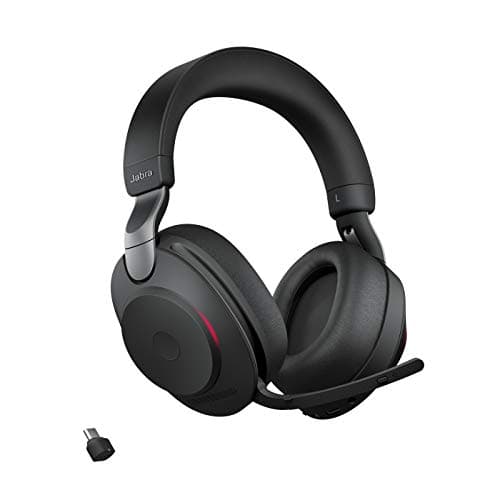
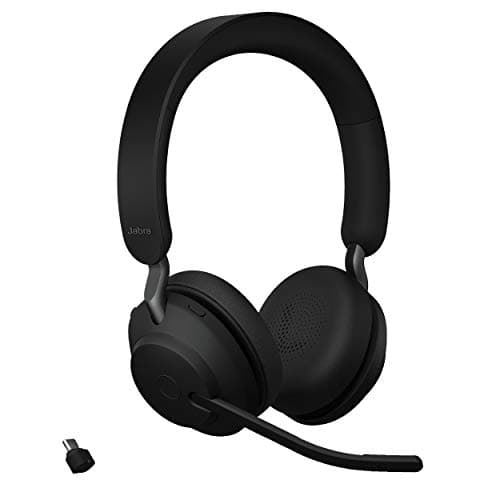
Jabra Jabra Evolve2 65 UC Wireless Stereo Headset
Jabra Evolve2 65 UC Wireless Stereo Headset

The default answer for a desk that takes calls all day: a Link 380 adapter in the box, a real boom arm, a busylight, and 35 hours of talk time, which makes charging a weekend problem rather than a daily one.

Best overall
8.9
$273.99Amazon
02
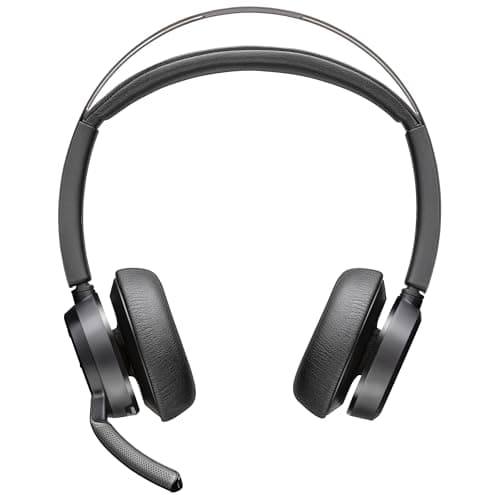
Poly Poly Voyager Focus 2 UC Bluetooth Headset
Poly Voyager Focus 2 UC Bluetooth Headset

The best microphone here for a room you do not control. Four microphones plus Acoustic Fence draw a boundary around your voice and discard what falls outside it, and the charging stand means it starts every day full.

Best microphone in a noisy room
8.7
$176.66Amazon
03
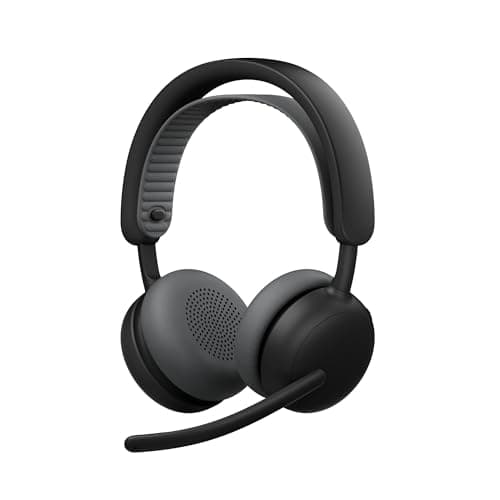
Logitech Logitech Zone Wireless 2 ES Noise Canceling Headset
Logitech Zone Wireless 2 ES Noise Canceling Headset

The one that works on the other person's noise as well as yours. Advanced Call Clarity suppresses the ambient sound arriving from the far end, which is a problem no other headset here even attempts to solve.

Best for bad audio on the other end
8.5
$159.99Amazon
04
Jabra Jabra Evolve2 85 Wireless Stereo Headset
Jabra Evolve2 85 Wireless Stereo Headset

Ten microphones, four of them running hybrid ANC, and a boom that retracts into the headband when you are not on a call. This is the pick for an open room or a shared house, and it is priced accordingly.

Best active noise canceling
8.3
$472.00Amazon
05
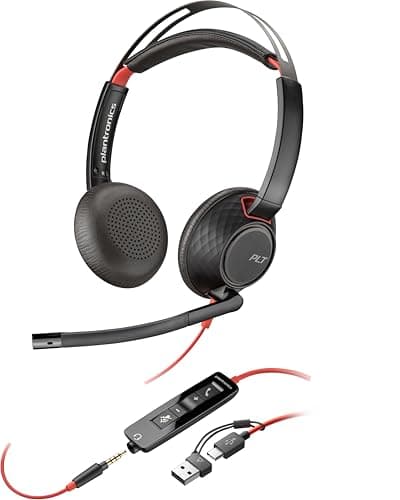
Poly Poly Blackwire 5220 Stereo USB-C Headset
Poly Blackwire 5220 Stereo USB-C Headset

The argument for wire. No battery, no pairing, no dongle to lose, a noise-canceling boom and inline controls - for roughly a quarter of what the wireless picks cost.

Best wired
8.1
$74.99Amazon
06
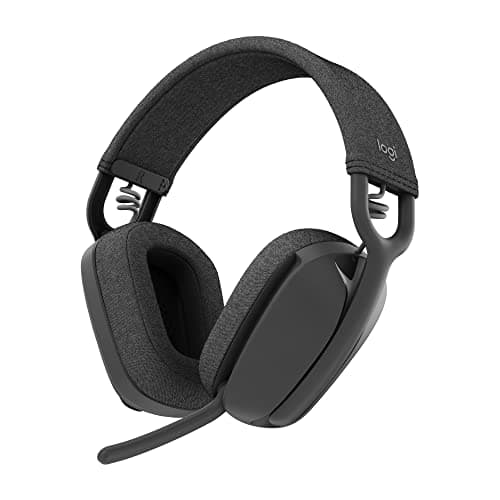
Logitech Logitech Zone Vibe 100 Wireless Headset
Logitech Zone Vibe 100 Wireless Headset

179 grams, a flip-to-mute boom that hides in the earcup, and multipoint to two devices. The compromise is the one this page cares most about: there is no USB receiver in the box, so it is plain Bluetooth all the way.

Best lightweight budget wireless
7.9
$79.99Amazon

#ad · Live prices from the Amazon Product API, as of Sep 6, 2026. Where we have no verified live price we show none — we would rather leave a gap than print a number that has rotted.

In detail

The picks, in full

01
Jabra Jabra Evolve2 65 UC Wireless Stereo Headset

Best overall

Jabra Evolve2 65 UC Wireless Stereo Headset

Microphones
3 digital MEMS, 100 Hz to 8 kHz
Boom
Yes - slide it up to mute
Noise canceling
Passive only - isolating foam oval cushions and angled earcups
Speakers
40 mm, 117 dB at 1 mW / 1 kHz
Battery
Up to 35 hrs talk with busylight off, 24 hrs with it on; up to 37 hrs music
Charge time
Up to 90 min
Wireless
Bluetooth 5.0, up to 30 m / 100 ft, Jabra Link 380 adapter included
Weight
176.4 g / 6.22 oz (stereo)
Certification
Certified for Microsoft Teams, Zoom Certified, works with Google Meet
8.9/10

The default answer for a desk that takes calls all day: a Link 380 adapter in the box, a real boom arm, a busylight, and 35 hours of talk time, which makes charging a weekend problem rather than a daily one.

Mic in a Noisy Room
9
Wearing Comfort
9.3
Connection Reliability
9.6
Value
7.6

Pros

  • The Link 380 adapter means the call does not depend on your laptop's Bluetooth stack, which is the biggest reliability difference on this page
  • 35 hours of talk time is genuinely a full week of meetings between charges
  • Sliding the boom up mutes the microphone - a physical mute you can feel, not a hotkey you have to find
  • The busylight on the boom turns red on its own whenever the mic opens
  • 176 grams is light enough to forget about by mid-afternoon

Cons

  • No active noise cancellation at all - the isolation is foam and earcup geometry, which is not the same thing
  • Bluetooth 5.0 rather than a newer revision
  • One of the more expensive headsets here despite skipping ANC

Skip this if…

you need the room to go quiet as well as the call to sound good - this one isolates passively, and the Evolve2 85 further down is the pick that actually cancels.

$273.99View on Amazon

Price as of Sep 6, 2026. Prices change — Amazon's is the one that counts.

#ad · we may earn a commission from this link to Jabra Evolve2 65 UC Wireless Stereo Headset

02
Poly Poly Voyager Focus 2 UC Bluetooth Headset

Best microphone in a noisy room

Poly Voyager Focus 2 UC Bluetooth Headset

Microphones
Four, with Acoustic Fence noise canceling, in a discreet boom
Active noise canceling
Digital hybrid ANC - high, low and off
Battery
Up to 25 hrs talk time with ANC and the online indicator off
Wireless
Bluetooth 5.1, up to 50 m / 164 ft, BT700 USB-A or USB-C adapter
In the box
Desktop charging stand
Certification
Certified for Microsoft Teams as a USB device and over native Bluetooth; certified for Zoom, Google Meet and Google Voice
8.7/10

The best microphone here for a room you do not control. Four microphones plus Acoustic Fence draw a boundary around your voice and discard what falls outside it, and the charging stand means it starts every day full.

Mic in a Noisy Room
9.5
Wearing Comfort
8.6
Connection Reliability
9
Value
7.7

Pros

  • Acoustic Fence is the most aggressive far-end noise handling here - it is built to ignore a room rather than gate it
  • Three-level ANC rather than a single on/off, so you can leave some of the room audible when you need to hear a door
  • 50 meters of range is roughly double most of the field - you can leave the desk without dropping the call
  • The charging stand removes the habit that kills wireless headsets: forgetting to plug them in
  • Teams certified both as a USB device and over native Bluetooth, which is rarer than it sounds

Cons

  • 25 hours is the optimistic figure, measured with ANC and the online indicator switched off; running both costs you hours
  • Poly does not publish a driver size or a weight for this model, so comfort is the one thing you cannot check on paper
  • The charging stand is another object that needs desk space and a cable

Skip this if…

your room is already quiet and you mostly want music between calls - you would be paying for microphone engineering you will never hear the benefit of.

$176.66View on Amazon

Price as of Sep 6, 2026. Prices change — Amazon's is the one that counts.

#ad · we may earn a commission from this link to Poly Voyager Focus 2 UC Bluetooth Headset

03
Logitech Logitech Zone Wireless 2 ES Noise Canceling Headset

Best for bad audio on the other end

Logitech Zone Wireless 2 ES Noise Canceling Headset

Microphones
5 omni-directional MEMS, four of them noise canceling
Far-end processing
AI-powered Advanced Call Clarity suppresses ambient noise from the other caller
Active noise canceling
Hybrid ANC, high and low modes, plus transparency
Speakers
40 mm with dynamic EQ
Battery
Up to 18 hrs talk with ANC off, 15 hrs with ANC on, 12 hrs with Advanced Call Clarity and ANC on; up to 40 hrs listening with ANC off
Quick charge
5 min for up to 1 hr of talk time
Wireless
Bluetooth 5.2, up to 50 m; USB-C receiver with USB-A adapter on receiver versions
Weight
230 g / 8.11 oz
Certification
Microsoft Teams (Premium Microphone for Open Office), Zoom, Google Meet, Google Voice, Intel Evo
8.5/10

The one that works on the other person's noise as well as yours. Advanced Call Clarity suppresses the ambient sound arriving from the far end, which is a problem no other headset here even attempts to solve.

Mic in a Noisy Room
9.2
Wearing Comfort
8.4
Connection Reliability
8.6
Value
7.8

Pros

  • Advanced Call Clarity cleans up the caller dialing in from a cafe - genuinely useful and genuinely rare
  • Transparency mode as well as two ANC levels, so you are not choosing between sealed and open
  • Five minutes on the cable buys an hour of talk time, which covers the meeting you forgot to charge for
  • Teams Premium Microphone for Open Office is a stricter certification tier than plain Teams certification

Cons

  • Logitech sells this in receiver and Bluetooth-only variants - confirm the SKU includes the USB-C receiver before ordering, because the receiver is the whole point
  • Turning on both ANC and Advanced Call Clarity cuts talk time to 12 hours, less than half the Jabra above
  • 230 grams is mid-pack, and it is a boomless design, so the microphones are doing more work than a boom would have to

Skip this if…

you want a visible boom - this is a headphone-shaped headset, and the capsules sit in the earcups rather than near your mouth.

$159.99View on Amazon

Price as of Sep 6, 2026. Prices change — Amazon's is the one that counts.

#ad · we may earn a commission from this link to Logitech Zone Wireless 2 ES Noise Canceling Headset

04
Jabra Jabra Evolve2 85 Wireless Stereo Headset

Best active noise canceling

Jabra Evolve2 85 Wireless Stereo Headset

Microphones
10 total - 4 analog MEMS and 6 digital MEMS
Boom
Hidden retractable boom arm
Active noise canceling
4-microphone digital hybrid ANC
Speakers
40 mm, 20 Hz to 20 kHz
Battery
Up to 26 hrs talk with ANC and busylight off, 21 hrs with both on; up to 37 hrs music with ANC off
Charge time
Up to 140 min
Wireless
Bluetooth 5.0, up to 30 m / 100 ft, Jabra Link 390 adapter included
Weight
286 g / 10.08 oz
Certification
Certified for Microsoft Teams and certified for Google Meet
8.3/10

Ten microphones, four of them running hybrid ANC, and a boom that retracts into the headband when you are not on a call. This is the pick for an open room or a shared house, and it is priced accordingly.

Mic in a Noisy Room
8.8
Wearing Comfort
8.6
Connection Reliability
9.4
Value
6.4

Pros

  • Genuine hybrid ANC across four microphones - the only pick here that makes a loud room quiet as well as making you sound clear
  • The boom retracts fully into the headband, so it works as ordinary headphones between meetings
  • 20 Hz to 20 kHz drivers mean music between calls is not an afterthought
  • Busylight, and the largest microphone array on the page

Cons

  • 286 grams is the heaviest headset here by a wide margin - you will notice it on a long day
  • By far the most expensive pick, and much of that money is the ANC hardware
  • 140 minutes to charge, and running ANC and the busylight costs about five hours of talk time
  • Still Bluetooth 5.0

Skip this if…

you already work somewhere quiet - you are paying a large premium and carrying 110 extra grams for cancellation you do not need.

$472.00View on Amazon

Price as of Sep 6, 2026. Prices change — Amazon's is the one that counts.

#ad · we may earn a commission from this link to Jabra Evolve2 85 Wireless Stereo Headset

05
Poly Poly Blackwire 5220 Stereo USB-C Headset

Best wired

Poly Blackwire 5220 Stereo USB-C Headset

Style
Wired stereo with a noise-canceling boom microphone
Audio
PC wideband audio with DSP and Dynamic EQ on the voice path
Isolation
Passive - soft ear cushions on a cushioned metal headband
Controls
Inline answer/end, volume and mute
Connections
USB-C cord with tethered USB-A adapter for PC, plus a 3.5 mm plug for phones and tablets
Certification
Microsoft Teams, Zoom, Chromebook, Google Meet and Google Voice
8.1/10

The argument for wire. No battery, no pairing, no dongle to lose, a noise-canceling boom and inline controls - for roughly a quarter of what the wireless picks cost.

Mic in a Noisy Room
8
Wearing Comfort
7.2
Connection Reliability
9.4
Value
7.8

Pros

  • A wired connection cannot drop, re-pair itself, or die at 3pm - it is the most reliable thing on this page
  • A tethered USB-A adapter plus a 3.5 mm plug covers a laptop, a desktop and a phone without a second headset
  • Inline controls with a mute LED, so the mute state is visible rather than guessed at
  • Cheapest pick here by a wide margin, and the one with the fewest things to go wrong

Cons

  • You are tethered - standing up mid-call means taking it off
  • Passive isolation only, and no busylight
  • Poly's own page does not publish a driver size, and the weight figures in circulation disagree, so treat comfort as something to check in person

Skip this if…

you pace during calls or move between a laptop and a meeting room - the whole point of the wireless picks above is that you can stand up.

$74.99View on Amazon

Price as of Sep 6, 2026. Prices change — Amazon's is the one that counts.

#ad · we may earn a commission from this link to Poly Blackwire 5220 Stereo USB-C Headset

06
Logitech Logitech Zone Vibe 100 Wireless Headset

Best lightweight budget wireless

Logitech Zone Vibe 100 Wireless Headset

Weight
179 g / 7.04 oz
Microphones
Dual MEMS with beamforming, 25 Hz to 16 kHz at -3 dB
Boom
Flip up to mute, tucks into a storage compartment
Speakers
40 mm - 100 Hz to 8 kHz in talk mode, 20 Hz to 20 kHz in music mode
Battery
Up to 20 hrs talk and music; 2 hr charge
Wireless
Bluetooth 5, up to 30 m / 98 ft, multipoint to two devices
USB receiver
None included - connects directly over Bluetooth
Active noise canceling
No
7.9/10

179 grams, a flip-to-mute boom that hides in the earcup, and multipoint to two devices. The compromise is the one this page cares most about: there is no USB receiver in the box, so it is plain Bluetooth all the way.

Mic in a Noisy Room
7.4
Wearing Comfort
9.4
Connection Reliability
6.8
Value
8

Pros

  • The lightest headset here at 179 grams, and the one people actually keep on all day
  • Multipoint to two devices, so a laptop call and a phone call do not require re-pairing
  • The boom folds away into the earcup, which makes it usable as ordinary headphones
  • Roughly a quarter of the price of the top pick

Cons

  • No USB receiver - this is plain Bluetooth, which is exactly the connection problem the rest of this page exists to avoid
  • No ANC, and the mic is a two-microphone beamformer rather than the four- and five-microphone arrays above
  • 20 hours is the shortest wireless runtime here
  • 30 meters of range, against 50 on the Poly and Logitech picks above

Skip this if…

calls are your job - the missing dongle is a real limitation, and the picks above exist because of it.

$79.99View on Amazon

$99.9920% off

Price as of Sep 6, 2026. Prices change — Amazon's is the one that counts.

#ad · we may earn a commission from this link to Logitech Zone Vibe 100 Wireless Headset

How to choose a headset for work calls

Why your headphones sound worse the moment you unmute

Bluetooth carries audio two ways, and they are not equal. A stereo profile sends a wide, full-range stream to your ears and carries no microphone at all. A hands-free profile carries both directions but narrows the bandwidth hard to fit them in. The instant a call opens the microphone, your headphones switch from the first to the second, which is why the music that sounded excellent thirty seconds ago now sounds like a phone from 2008.

A bundled USB adapter sidesteps the whole problem. It runs its own link to the headset rather than negotiating with your laptop’s Bluetooth stack, keeps the microphone wide, and always reconnects to the same device. It also means the headset is not competing with a mouse, a keyboard and a phone for the same radio. Five of the six picks above ship one; the sixth does not, and that is the single reason it ranks last rather than higher.

Boom, beamformed, or neither

A boom microphone sits two to three inches from your mouth. At that distance your voice is enormously louder than the room, and no processing has to work very hard. A boomless headset puts the capsules in the earcups, roughly a foot away and pointing sideways, then uses an array of microphones and beamforming to work out which direction your voice came from. Modern arrays are good — the Logitech pick above uses five microphones and does it well — but they are solving a problem a boom does not have.

The practical test: if you take calls from a room with hard floors, a window, or other people in it, buy the boom. If you are mostly in a quiet room and you care what you look like on the webcam, boomless is a fair trade.

ANC and noise suppression are not the same feature

Active noise cancellation points microphones outward, measures the low frequencies arriving at the earcup, and plays an inverse signal to cancel them. It works on hums, fans, traffic and air conditioning, it is much weaker on speech, and it changes only what you hear.

Microphone noise suppression runs in the opposite direction: it decides how much of your room reaches the far end. Poly calls its version Acoustic Fence; Jabra builds it into a ten-microphone array; Logitech extends it to clean up the othercaller’s room as well. A headset can have superb ANC and an average transmit path, or the reverse. Read the two claims separately, because the box will not separate them for you.

Certification tells you the buttons work

“Certified for Microsoft Teams” means the platform tested the device, the Teams button opens Teams, and pressing mute on the headset shows you as muted in the app rather than silently desynchronizing. That is worth having — the mismatch between hardware mute and software mute is a common source of talking to nobody for ninety seconds — but it is not a sound quality rating and it is not a reason to pay more on its own.

Weight, clamp and the six-hour mark

The range on this page is 179 grams to 286 grams, and the difference is batteries, microphone arrays and ANC hardware. Nothing on your head feels heavy in the first hour. By the sixth, a hundred grams is the difference between forgetting you are wearing it and taking it off between meetings. If your day is wall-to-wall calls, weight is a more useful specification than battery life, because a headset you have taken off is not helping anyone.

Wired still wins on two things

A cable cannot run out of charge and cannot pair with the wrong device. For a desk that does not move — or a standing deskwhere the cable run is already planned — a wired headset removes two failure modes for a fraction of the price. The cost is that you are attached to the desk, and that there is one more cable to route, which is what under-desk cable management is for.

Where the headset sits in the rest of the desk

A headset solves both halves of a call at once, which is why it is usually the first call-related purchase rather than the third. The alternative — a USB microphone plus desk speakers— sounds better and looks better on camera, but it costs more, takes desk space, and brings echo cancellation into play the moment the speakers are loud enough for the microphone to hear them. Headset first if you are on calls all day; microphone and speakers if you also record, stream, or listen to music properly. Either way, lighting is the part everyone forgets, and the accessories guide puts the whole queue in order.

Essentials

The small parts that finish the job

Nothing here changes a pick above, and none of it is a considered purchase. These are the cheap pieces that decide whether the expensive one works properly, and the ones people discover they are missing on the day the big box arrives.

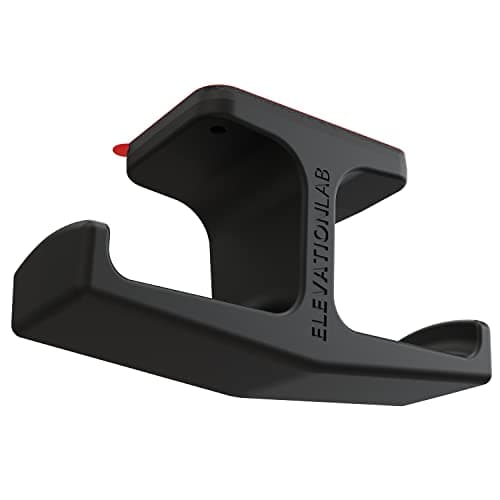
  • Elevation Lab The Anchor Under-Desk Headphone Mount

    Elevation Lab The Anchor Under-Desk Headphone Mount

    A headset left on the desk takes up the same surface an arm or a riser was bought to give back. Under the front edge it hangs in dead space, out of the way of the keyboard and off the cables.

    Check first: adhesive mounts want a smooth, clean underside. Rough or heavily textured laminate will not hold one.

#ad · Live prices from the Amazon Product API, as of Sep 6, 2026. Where we have no verified live price we show none. We may earn a commission, at no extra cost to you.

How we picked

We do not run a testing lab

We compiled the published manufacturer specifications, did the ergonomics, VESA and desk-depth math ourselves, and read aggregated owner reviews, then scored each product against a published rubric. The scores are judgments from documented research — they are not measurements we took, because we do not have a lab and we are not going to pretend we do. Every spec traces back to a listing or manual named in Sources.

Questions

Frequently asked

Do I really need the USB dongle, or is Bluetooth good enough?
For occasional calls, Bluetooth is fine. For calls as a job, the dongle is the difference. Plain Bluetooth has to switch to a hands-free profile to carry your microphone, which narrows the audio in both directions; a bundled USB adapter runs its own link and avoids that entirely. It also reconnects to the same device every time instead of grabbing whichever phone is nearest.
Is a boom microphone actually better than a headset without one?
In a room you do not control, yes. A boom sits two to three inches from your mouth, so your voice arrives far louder than the room and no processing has to rescue it. Boomless headsets use microphone arrays and beamforming to approximate that from a foot away, and the good ones get close — but they are solving a problem the boom never had.
Will active noise cancellation make me sound better to other people?
No. ANC changes what you hear, not what they hear. What reaches the far end is decided by the microphone array and its noise suppression, which is a completely separate system. A headset can have strong ANC and an ordinary transmit path, so check both claims rather than assuming one implies the other.
What does Teams or Zoom certified actually mean?
That the platform tested the hardware and that the controls behave: the dedicated button opens the app, and the headset mute and the software mute stay in sync. It is a usability guarantee, not a sound quality rating. Plenty of uncertified headsets sound excellent; they just may not light up the right button.
Wired or wireless for a home office?
If the desk does not move, wired is cheaper, cannot run out of battery and cannot pair with the wrong device. Wireless earns its price when you stand up during calls, move between a laptop and another room, or want one headset for a phone as well. Battery life only matters once you have chosen wireless for a reason.

Keep reading

Receipts

Sources

We do not run a testing lab, and we do not pretend to. Specifications come from the manufacturer or retailer listing; the footprint and clearance math is ours and reproducible. Where we could not verify a number, we say so on the page rather than quietly leaving it out. Read our full method.