Buy the Herman Miller Aeronif you run warm, sit fairly upright, and are willing to choose a frame size — it is the better chair for a hot room and an all-day typing posture. Buy the Steelcase Leap V2 if your thighs are long or short enough that a fixed seat pan has never quite worked, or if you recline deeply and want the seat to follow you. Both are flagship chairs at flagship money, and the decision between them is almost entirely about your body, not about build quality.
The two get compared constantly because they land at the same price and have dominated the same shortlists for twenty years. They are not, however, variations on one design. They disagree about what a seat should be made of, about whether a chair should be sized or adjusted, and about what happens when you lean back. Work through those three disagreements and the answer usually becomes obvious.
Disagreement one: suspension or foam
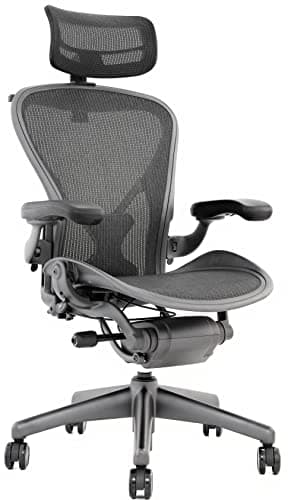
The Aeron has no foam in it. The back and the seat are both 8Z Pellicle, an elastomeric suspension stretched over the frame in eight zones of varying tension, so your weight is carried by a membrane rather than a cushion. The practical consequences are heat and pressure. Air moves straight through the seat, which is why the Aeron is still the chair to beat in a warm room or a converted loft in July. Pressure is spread rather than absorbed, which most people read as firm.
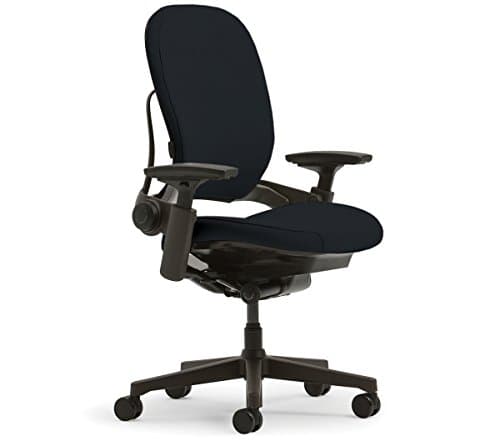
The Leap V2 is upholstered: a foam seat and back under fabric, leather or vinyl, with 3D Knit available on the back. It is warmer. It is also softer at first contact, and it is the chair people reach for when a mesh seat edge has bothered the back of their thighs. If you have ever stood up from a mesh chair with a line pressed into your leg, that is the specific complaint the Leap does not produce.
Neither material is more ergonomic than the other. The relevant question is the room temperature and whether you like to feel held or feel supported. Our mesh office chair roundup separates suspension mesh like the Aeron’s from the panel mesh used on cheaper chairs, which is a distinction worth understanding before you decide mesh is or is not for you.
Disagreement two: sized or adjusted
This is the one people skip, and it is the one that decides most returns. The Aeron is sold in three frame sizes, and the size changes the seat itself. Herman Miller publishes the numbers: size A gives a 16 in seat depth, a 27.5 in width and a 14.4 to 19.3 in seat height; size B gives 17 in depth, 28.3 in width and 14.8 to 22.8 in height; size C gives 18.5 in depth, 28.3 in width and 15.8 to 22.8 in height. You pick one at purchase, and the seat pan depth is then fixed for the life of the chair.
The Leap V2 takes the opposite approach: one chair, with an adjustable seat depth you slide to suit your leg length, plus adjustable lumbar height and firmness and arms adjustable for height, depth, width and pivot. If you are between Aeron sizes — and plenty of people are, particularly between A and B — the Leap sidesteps the problem entirely.
That cuts the other way too. If you know you are a clean size B, the Aeron arrives already correct and there is one fewer control to get wrong. Measure before you decide either way: our office chair sizing guide has the seat depth and height method, and it is ten minutes with a tape measure against a chair you already own.
Disagreement three: what happens when you recline
The Aeron reclines with a tilt mechanism, offered with a tilt limiter and seat-angle options, and it is at its best holding one supported, fairly upright position. It is a chair for working, not for leaning back to read.
The Leap V2 reclines with the Natural Glide System: as the back goes back, the seat glides forward, so your eyes stay closer to the screen instead of travelling away from it. Combined with LiveBack, which changes the shape of the backrest as you move, it is noticeably the better chair for someone who shifts position all day or takes calls leaning back. Steelcase rates the Leap to 400 lb and backs it with a limited lifetime warranty quoted as 12 years, multi-shift, parts and labor; Herman Miller’s Aeron warranty is 12 years, 3-shift, with limited exceptions. Neither is the weak link.
The short version
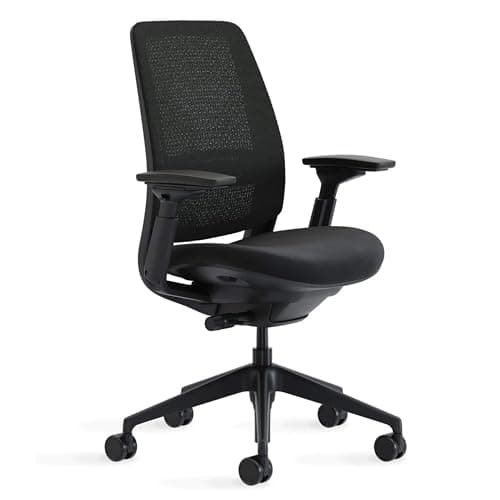
Hot room, upright posture, confident about your size: Aeron. Long or short thighs, deep recline, prefer a padded seat: Leap V2. Not willing to spend flagship money at all: the Steelcase Series 2 below carries most of the Leap mechanism story at a fraction of the price, and it is the honest third answer to this question.
How the two chairs compare, line by line
| Specification | Aeron | Leap V2 |
|---|
| Seat material | 8Z Pellicle suspension, no foam | Upholstered foam |
| Seat depth | Fixed by size: 16, 17 or 18.5 in | Adjustable on the chair |
| Sizing | Three frames, A / B / C | One frame, adjusted |
| Seat height | 14.4-19.3 in (A) to 15.8-22.8 in (C) | Not published as a range by Steelcase |
| Back | Pellicle over frame, PostureFit SL | LiveBack, adjustable lumbar height and firmness |
| Recline | Tilt, with limiter and seat-angle options | Natural Glide — seat moves forward |
| Weight capacity | Not published per size | 400 lb; 500 lb on Leap Plus |
| Warranty | 12-year, 3-shift | 12 years, multi-shift, parts and labor |
Two gaps in that table are real and we are not going to fill them with guesses. Herman Miller does not publish a per-size weight capacity for the Aeron on its specification page, and Steelcase does not publish a seat height range for the Leap. If either number is the deciding factor for you, ask the seller before you buy rather than trusting a figure copied around the internet.
Which one to buy, by situation
Your room is hot. Aeron. This is not close. A suspension seat is the only seat here that air moves through, and no amount of fabric choice on the Leap changes that.
You are at the edges of average height.Leap V2, probably. The Aeron’s A and C frames exist for exactly this reason and they work, but an adjustable seat depth is a safer bet than committing to a fixed pan.
You lean back to think.Leap V2. Natural Glide is the feature that makes a deep recline usable at a desk rather than something you have to come out of to type. If your arms also move all day — phone, tablet, stylus — the armrests are the next decision, and that is Leap vs Gesture.
You want a chair you can resell in ten years. Aeron, by a margin. A chair with no foam in it has nothing to flatten, and the used market prices that in.
You cannot spend flagship money. Series 2, and spend the difference on a footrest and a chair matinstead. A correctly set up mid-range chair beats a badly set up flagship every time — our chair adjustment guide is the free upgrade most people have not done yet.
What neither chair fixes
A flagship chair cannot correct a desk at the wrong height, and most home desks are too high. If your shoulders rise to reach the keyboard, you will feel it in your neck in either chair. Check your numbers with the desk height guide, and if the desk is fixed and too tall, an under-desk keyboard tray is a far cheaper fix than a chair.