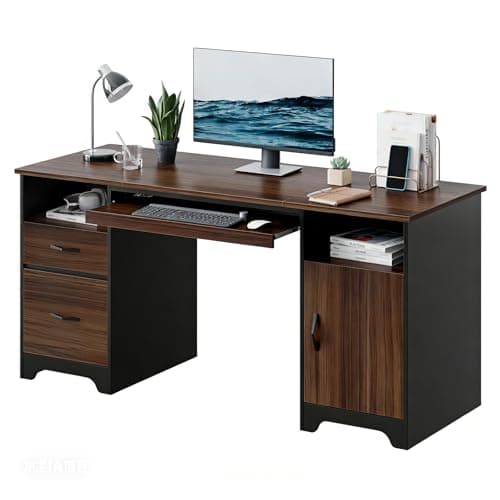
Every drawer in a desk is bought with something else. A pedestal of drawers takes the legroom on one side and the underside where a cable tray or a tower would go. A shallow center drawer takes an inch of thigh clearance. A hutch takes the air a monitor arm needs. None of that makes storage a bad idea — a desk that swallows the stationery and the paperwork is the single biggest contributor to a desktop that stays clear — but it does mean the right question is not “how many drawers” but “what am I paying for them with.”
Decide what the drawers are for first
Three jobs, and they want different desks. If the job is paperwork, you need one deep file drawer that takes hanging folders, and the other drawers barely matter; a desk with a proper file drawer replaces a filing cabinet and reclaims the floor it stood on. If the job is small clutter— pens, cables, dongles, the things that migrate across a desk — then several shallow drawers beat one deep one, because a deep drawer full of small things is a bin. If the job is bulk, a cabinet with a door does more than any drawer, because you can put things in it that are not drawer-shaped.
What the pedestal costs underneath
This is the trade-off nobody photographs. A drawer pedestal occupies the space where three things normally live: your legs when you sit at an angle, a desktop tower, and the under-desk cable tray that keeps the whole rig serviceable. On a 48-inch desk with a pedestal on one side, you have roughly half the underside left, and it has to hold all three.
The practical order of operations: if a tower has to live under the desk, buy a reversible desk and put the pedestal on the opposite side. If a cable tray is going under there, check there is a clear run of underside at least 17 inches long for a standard tray. And if you use a footrest, remember the pedestal narrows the space it has to sit in.
Runners are the part that fails
At this price point drawers ride on one of two things: plastic side runners, or metal ball- bearing slides. The plastic ones work fine when the drawer is light and start sticking and racking once you load them with paper, which is precisely what a file drawer is for. Metal slides cost more and are the difference between a desk you still like in three years and one whose bottom drawer you stop opening. When a listing does not say, assume plastic.
The second durability point is how the pedestal attaches. On better desks the drawer cabinet is a structural member that supports the top; on cheaper ones it hangs off the underside, and that joint is where a loaded desk starts to sag. A desk whose cabinet reaches the floor is generally the stronger design.
Storage and monitor arms are in competition
If you intend to mount a screen, check the rear edge before you buy. Hutches, back rails, and full-width storage bases all block the clear stretch of edge a monitor arm clamp needs, and a desk that is otherwise perfect can be unusable for mounting. A grommet hole through the top is the alternative, but most storage desks do not have one and drilling through a laminate top over a cabinet is not a casual job. The full reasoning is in monitor arm vs stand.
How this list is ranked
Usable desktop first, because a desk you cannot work on is not solved by storage; then the storage itself, then build, then value. Everything comes from published manufacturer dimensions and listings rather than a lab — see how we pick. If your priority is surface rather than storage, the home office desks and dual-monitor desks roundups are the better starting points.
How to choose a desk with drawers
Answer four questions in order. What is the storage for — files, small clutter, or bulk? Which side can lose its legroom, and does the desk reverse so you can choose? What else needs to live under the desk — a tower, a cable tray, a footrest — and does the remaining space fit it? And will a monitor arm need to clamp to the rear edge?
Then check the two specs listings bury. Drawer runners: metal ball-bearing slides if the desk says so, and assume plastic if it does not. And working depth: a desk with a drawer pedestal often has a shallower top than its width implies, and the number you want is at least 24 inches if a monitor will sit on its own stand.
One alternative worth naming, because it frequently wins: a plain desk plus a separate rolling drawer unit. It costs about the same, keeps the entire underside of the desk open for cables and legs, and can be moved out of the way when you need the space. A built-in pedestal is tidier and permanent; a rolling unit is uglier and flexible. If you are still building the rest of the setup, the sequencing in the complete desk setup guide covers where storage should land in the order of purchases.