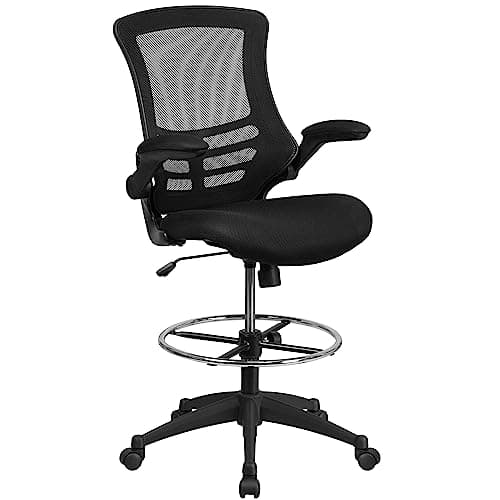
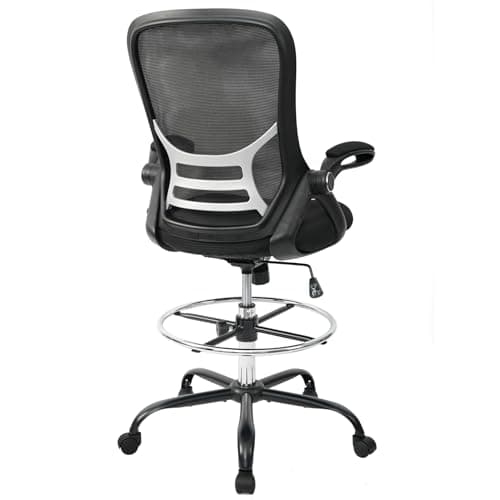
If you perch at a raised desk for part of the day, buy a drafting chair — the HYLONE high-back is the one here with real back support as well as an adjustable foot ring. If you sit at a desk between about 25 and 30 inches, buy a task chair; a drafting chair at that height is simply a worse office chair. The whole decision comes down to one number that most listings bury: how high the seat goes.
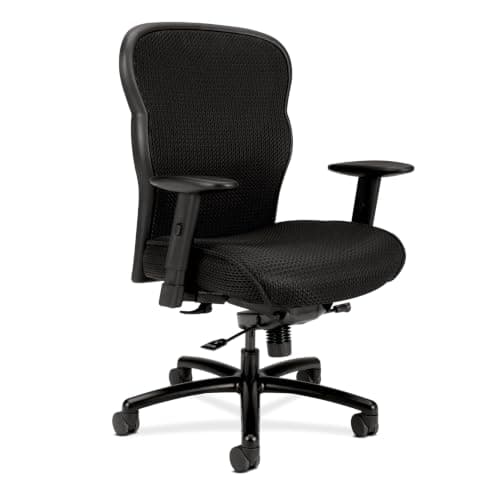
Here is the scale of it. The HON Wave, the highest-seat task chair we rank anywhere on this site, publishes a seat height range of 19.25 to 22.25 inches. A sit-stand desk at a typical standing height is in the 40s. A task chair is not a few inches short of that — it is not in the conversation. The drafting chair exists to fill a gap of roughly a foot.
The foot ring is the actual engineering
Raising a seat without raising the floor creates a specific problem: your feet leave the ground, so your legs hang from the front edge of the seat. The seat pan then carries weight it was not designed to carry, concentrated behind the knee, and you shift and fidget to relieve it.
A drafting chair answers that with a foot ring— a circular rail that gives your feet a surface at the height they now need one. All three drafting options on this page have one, and the HYLONE and Flash Furniture rings are height-adjustable so the ring can follow the seat. Buying a “tall office chair” without a foot ring reproduces the problem at a higher price.
What you give up
Drafting chairs are built around the height mechanism, and the back usually pays for it. Expect a shorter backrest, less lumbar adjustment, and often flip-up arms rather than the 3D or 4D armrests a mid-range task chair now ships with. That is why this comparison does not have a winner: for eight hours of seated desk work, one of the chairs in the ergonomic office chair roundup is a better chair in every way that is not height.
The chairs that keep the most back support are the high-back drafting designs, and that is the axis our drafting chair roundup ranks on. If long hours are the real issue, long-hours chairs covers what fails late in the day.
The third option: a leaning stool
A perching or leaning stool is not a chair at all. You rest on it rather than sit in it, with your hips open and your spine close to upright, and it keeps your feet on the floor taking some of the load. It has no back, which is the honest trade-off, and it is the lightest and smallest of the three options.
Used properly, a stool is a third posture rather than a replacement for either chair: sit for a while, stand for a while, perch in between. Standing desk ergonomics covers how to alternate, and the point of alternating is that no single posture is good for eight hours.
Before you buy either: can the desk come down?
The cheapest fix is often to stop raising the desk. If yours is electric with memory presets, set one to your correct seated height — measured from your elbows, not from a standard — and keep a normal task chair. The drafting chair question only arises for a desk that is fixed high, a counter, a workbench, or a sit-stand desk you genuinely want to perch at rather than stand at.
If the desk is fixed too high and cannot change, a drafting chair plus a desk that finally fits is one route and a keyboard tray that lowers the typing surface is the other. The tray is usually cheaper and does more for your wrists.
What separates the two, feature by feature
| Feature | Task / office chair | Drafting chair | Leaning stool |
|---|
| Typical seat height | About 16 to 22 in | Into standing-desk range | Into standing-desk range |
| Foot support | The floor | Foot ring | The floor |
| Backrest | Full, often adjustable | Short to high, rarely adjustable | None |
| Armrests | Commonly 3D or 4D | Flip-up or none | None |
| Best for | A full seated day | A raised or fixed-high desk | Alternating with standing |
One honest limitation: none of the three drafting options here publishes a seat height range, and that is the number this decision turns on. Before you buy, measure the underside clearance of your desk at the height you will perch at, then check the specific listing's own figure. We will not quote a range a manufacturer has not stated.
Pick by the desk, not by the chair
Desk between 25 and 30 in, adjustable or not: task chair. This is the overwhelming majority of desks, and the drafting question does not apply.
Sit-stand desk you mostly sit at: task chair, and set a seated memory preset. Perching at a raised desk is a nice option, not a plan.
Counter, workbench or fixed-high desk: drafting chair with an adjustable foot ring. There is no good alternative and a task chair will hurt.
Sit-stand desk you mostly stand at: leaning stool. You want somewhere to take the load off without leaving the standing height.
Desk that is too high and will not move: consider a keyboard tray first. Lowering the typing surface by two to six inches fixes the arms and the wrists at a fraction of the cost of a new chair.
Three things that go wrong at height
Getting in and out. A tall chair on casters wants to roll away as you sit. A five-point base helps; a wall or desk edge to brace against helps more.
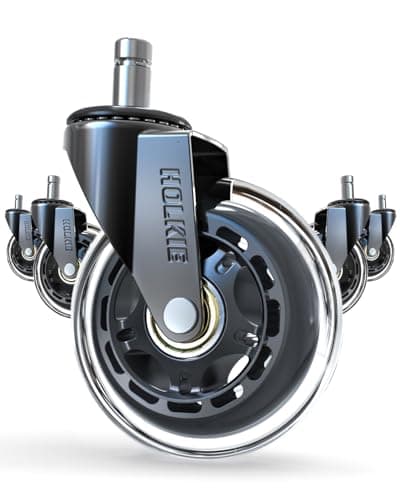
Casters on the wrong floor.Hard casters on a hard floor at height is a bad combination. Soft PU casters are the fix and they are a ten-minute swap — see the essentials above.
The screen stays where it was. Raising yourself a foot without raising the monitor puts you looking down at it all day. Monitor height has the method, and an arm is what makes it adjustable at all. If you alternate heights, an under-desk footrest covers the seated half of the day.