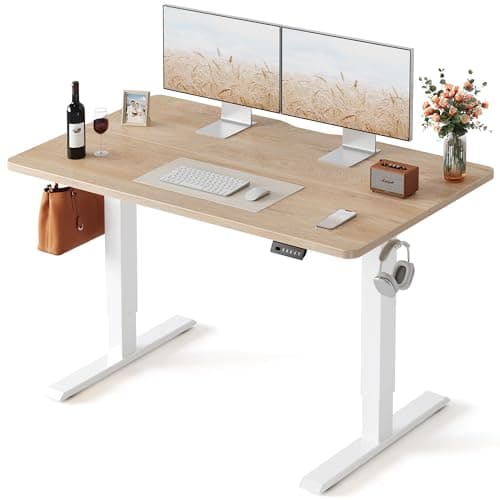
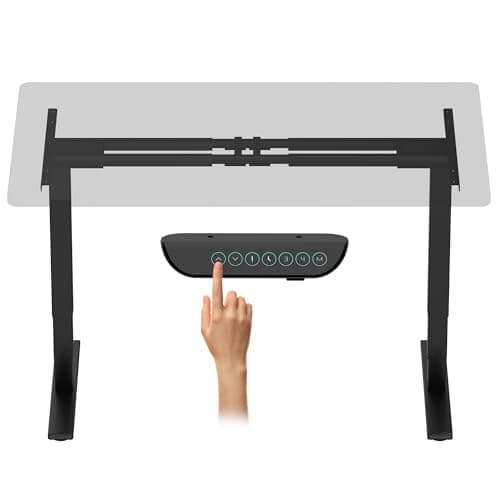
Buy a complete desk unless you have a reason not to. The FlexiSpot E6 Pro arrives as a 55 by 28 inch desk with a pre-drilled top and a four-preset keypad, and it is finished in an evening. Buy the FLEXISPOT E6 Max frameinstead when the top is the point — an unusual width, a real wood slab, a depth no complete desk ships, or a surface you already own and like. The frame route is about control of the surface, not about saving money.
The pricing intuition is usually backwards. A frame plus a decent top frequently lands at or above the price of a complete desk at the same height and capacity, because the laminate top on a complete desk is the cheapest part of it. What the frame buys is the four numbers below.
1. The top size you can actually fit
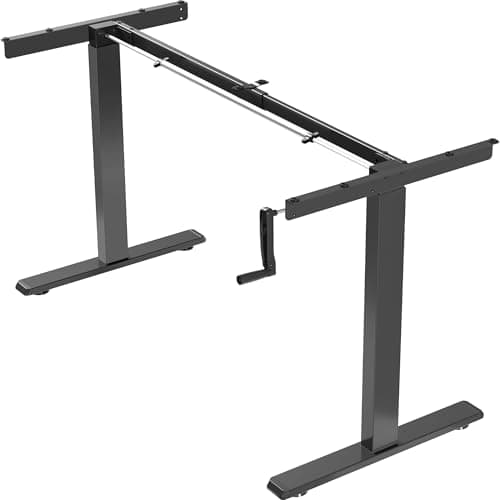
This is the strongest argument for a frame, and VIVO is the maker that publishes it clearly: its manual frame supports tops from 34 to 72 in long and 23 to 43 in deep, with a 3/4 in minimum thickness and a frame width that adjusts from 34 to 52.3 in. Forty-three inches of supported depth is far past anything a complete desk at this price sells, and it is the answer for a corner, an alcove, or a triple-monitor setup that needs the screens further away.
Complete desks come in the sizes they come in. The E6 Pro is 55 by 28 in; the FEZIBO here is 48 by 24 in. Both are sensible and neither is negotiable. The desk depth guide does the arithmetic on whether 24 inches is enough for your monitors.
2. The height ceiling, and the inch the top adds
On a frame-only product the published range is the frame, so the finished working surface sits higher by the thickness of whatever you bolt on. The E6 Max frame runs 24.4 to 50 in; with a 1 in top the desk is about 51 in at the top of its travel. That inch is free height, and for a tall user it is the whole reason to go frame-only — standing desks for tall people goes through the ceilings model by model.
It also works against you at the bottom. A frame with a 24.4 in minimum plus a 1.5 in butcher block has a 25.9 in minimum, which matters if the desk has to go low enough for a shorter user to sit at it properly.
3. Weight capacity
Frames publish capacities and complete desks often do not. The E6 Max frame is rated 330 lb; the VIVO manual crank frame is rated 132 lb, which is a real constraint once a heavy top is part of the load. FlexiSpot publishes no capacity figure for the complete E6 Pro at all, and that absence is itself a reason some buyers prefer a frame: you can at least read the number.
Do the arithmetic including the top. A 60 by 30 in solid wood slab is heavy before anything sits on it, and that weight comes off the budget available for monitors, an arm and a PC. The frame build guide works through the load and the drilling order.
4. Who warranties the surface
A complete desk is one product with one warranty. A frame plus a top is two products, and the top usually has none worth naming — and once you drill it, nobody is taking it back. The VIVO frames here carry 3 years; the top is on you.
The practical version of this is the holes. A complete desk arrives pre-drilled— the FEZIBO below says so in its own assembly spec, and the frame simply bolts to the marked points. On a frame-only build you are marking and drilling into your own surface, and a misplaced pilot hole in a veneered top is permanent. If that sentence makes you uneasy, buy the complete desk; that is a legitimate reason, not a failure of nerve.
What each route gives you
| Frame only | Complete desk |
|---|
| Top size | Your choice, within the frame's stated range | Fixed by the model |
| Top material | Anything that meets the minimum thickness | Usually laminate chipboard |
| Height ceiling | Frame range plus top thickness | As published |
| Published capacity | Usually yes (330 lb / 132 lb here) | Often not stated |
| Drilling | You mark and drill | Pre-drilled |
| Warranty | Frame only | Whole desk |
| Grommet holes | Where you want them | Where the maker put them, if any |
Five reasons to go frame-only
The room is an awkward shape. A 70 in top in an alcove, or a 40 in top in a box room, is a size nobody sells as a finished desk.
You want a real wood surface. Laminate chipboard is the one part of a complete desk you cannot upgrade later.
You are tall. The top's thickness adds to the ceiling, and that inch is the difference between a desk that reaches your elbows and one that does not.
You already own a top you like. A door, a slab, an old desk's surface. Check it against the frame's stated minimum thickness first.
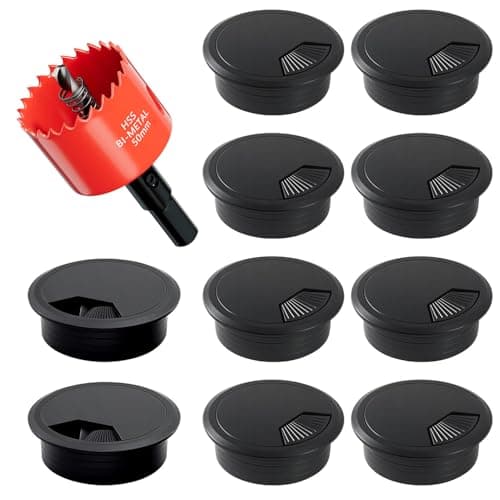
You want the grommets in the right places. Cutting your own cable holes before the desk is loaded is far easier than living with holes someone else chose, and it is the tidiest route for a tray and a power strip underneath.
Three reasons not to
You do not own a drill, or do not want to use one on furniture. Completely reasonable. The pre-drilled top exists for this.
You want one company to blame. A finished desk is one warranty. A frame plus a slab is a conversation between two suppliers.
You expected it to be cheaper. Price a frame and a top you would actually be happy with, and compare that total with a complete desk at the same height and capacity before committing. If stability rather than price is the worry, the wobble guide covers the crossbar and stabiliser-bar options on both routes, and the frame roundup ranks the frame-only field on its own merits.