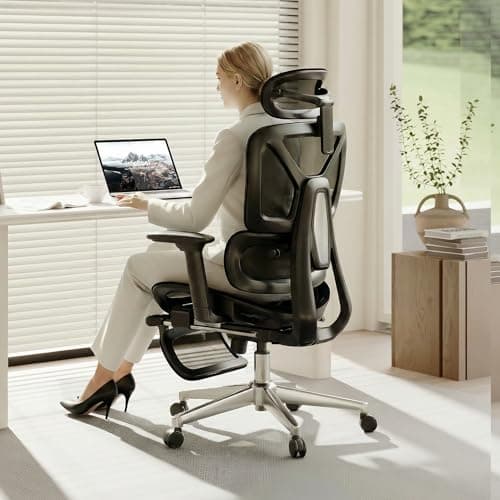
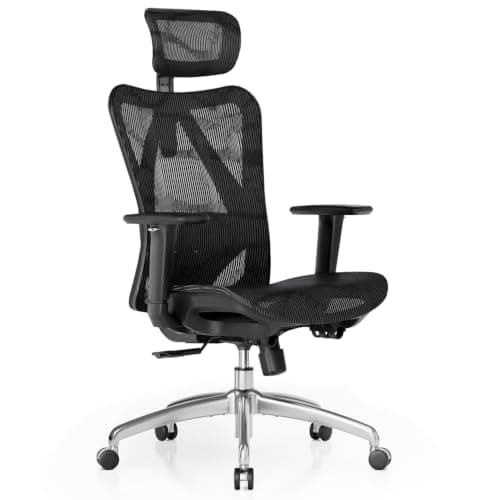
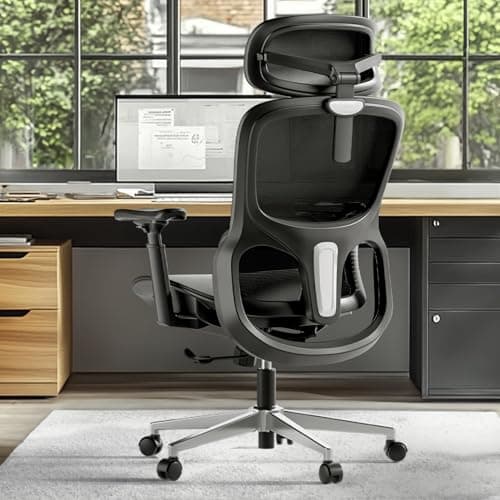
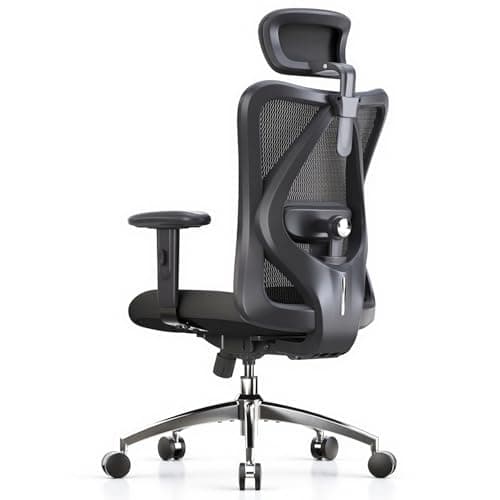
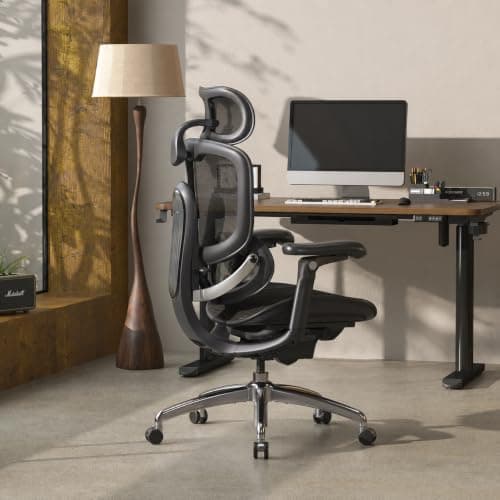
The chair to buy under $500 is the SIHOO Doro C300 Pro V2: a dynamic self-adjusting lumbar, 8D armrests, a 3D headrest and three locked recline angles, which is a flagship feature list at a mid-market price. If you want a footrest built in, the FlexiSpot ErgoX is the pick — dynamic lumbar, 3D arms, 3D headrest, a retractable footrest and a 400 lb published capacity. And the budget pick is the SIHOO M18: the cheapest chair here whose headrest actually adjusts, which is the feature budget chairs fake most often.
This band is worth treating as its own category because of what happens either side of it. Below about $200, makers delete adjustments to hit the price: the lumbar becomes a fixed bump in the backrest, the armrests stop moving, the headrest gets riveted in one position. Above $600 you start paying for materials, warranty and resale value rather than for more adjustment. Under $500 is the band where you get most of the adjustment and none of the warranty — and knowing which is which is the whole purchase.
The four specifications to rank on
- A lumbar you can set. Not “lumbar support” — every chair claims that. Look for height and depth adjustment, or a dynamic lumbar that tracks you. A fixed lumbar bump fits whoever it happens to fit, and if that is not you, it is worse than nothing. Our back pain roundup ranks on lumbar fit alone.
- Armrests that move in three directions or more. Height is the minimum. Forward and back matters almost as much, because that is what gets your elbows under your shoulders rather than behind them. Pivot and width round it out. “3D” and “4D” are maker shorthand for how many of those four you get.
- A headrest that positions. A headrest fixed at the average head height pushes a shorter person’s head forward and misses a taller person’s entirely. Adjustable is the only version worth paying for.
- A published weight capacity. Not because you are near it, but because a maker who publishes 330 or 400 lb is telling you something about the gas cylinder and the base — the two parts that actually fail. A listing with no rating at all is a gap, and we have flagged it where it occurs.
What each chair publishes
| Chair | Lumbar | Armrests | Headrest | Published capacity |
|---|
| SIHOO Doro C300 Pro V2 | Dynamic, self-adjusting | 8D | 3D | 330 lb |
| FlexiSpot ErgoX | Dynamic, 5-level back | 3D | 3D, plus a retractable footrest | 400 lb |
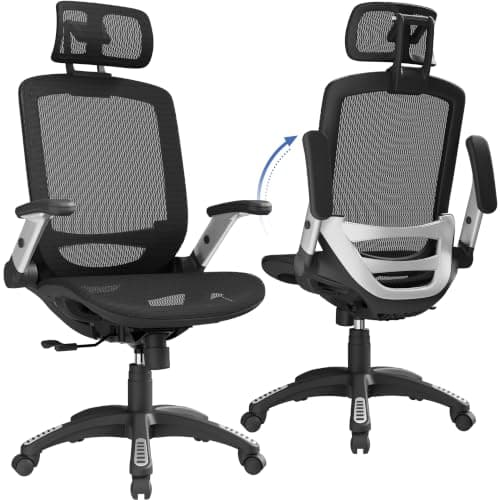
| Gabrylly Mesh | No independent height adjustment | Flip-up, fixed | 2D | 280 lb |
| SIHOO M57 | Dual-adjustable: height and depth | 3D | Adjustable | 330 lb |
| Hbada P2 | 3D: height, depth and width | 3D, 360-degree rotation | No headrest | Not published |
| SIHOO M18 | Adjustable | Adjustable | Adjustable | Not published |
Two readings of that table are worth spelling out. The Hbada P2 has the most precise lumbar here — three axes, which is genuinely flagship-grade — and no headrest and no published capacity, so it is a specialist rather than an all-rounder. And the Gabrylly is the one chair here whose adjustments are mostly absent; it is on the list because full breathable mesh and flip-up arms genuinely suit a small room, not because it competes on adjustment.
What you do not get under $500
Two things, and both are reasons people spend more rather than marketing noise. Warranty length is the first: a Steelcase Series 2 carries a 12-year mechanism warranty and a Herman Miller Aeron a 12-year three-shift warranty, where the chairs here run to three or five years. Over a decade of daily use that is the real difference, and how long office chairs last sets the published warranties against what actually wears out. Parts is the second: a flagship has a spare-parts channel and a budget chair does not, so a failed cylinder means a new chair rather than a new cylinder. If the gap in resale and service is what you are weighing, our SIHOO versus Herman Miller comparison is the argument in full, and Aeron alternatives approaches it from the other direction.
Price check. 5 of the 6 picks below were listed under $500 on Amazon as of November 12, 2026— the figure on each buy button is the live one, and where we have no verified price we show none rather than a number that has rotted.
The short answer
Quick picks
| # | Product | Best for | Score | Price |
|---|
| 01 | SIHOO Doro C300 Pro V2 Ergonomic ChairThe best adjustment-per-dollar in this band. A dynamic self-adjusting lumbar, 8D armrests, a 3D headrest and three locked recline angles read like a chair from the tier above. | Best overall under $500 | | Check price → |
| 02 | FlexiSpot ErgoX Ergonomic Office ChairThe one chair here with a footrest built in, and the highest published capacity on the page at 400 lb. Dynamic lumbar, 3D arms and a 3D headrest alongside it. | Best with a built-in footrest | | $279.99·Amazon |
| 03 | SIHOO M57 Ergonomic Mesh ChairThe value all-rounder. A dual-adjustable lumbar set for height and depth, 3D arms, an adjustable headrest and a 330 lb rating, on an S-curve mesh back. | Best all-round value | | $199.99·Amazon |
| 04 | Hbada P2 Ergonomic Office ChairThe most precise lumbar on the page: three axes - height, depth and width - which is flagship-grade adjustment. No headrest, and Hbada publishes no weight rating. | Best lumbar adjustment | | $209.99·Amazon |
| 05 | Gabrylly Ergonomic Mesh Office ChairThe small-room pick rather than the adjustment pick. Full breathable mesh, a 2D headrest and flip-up arms that let the chair disappear under the desk when you are done. | Best for a small room | | $219.99·Amazon |
| 06 | | Budget pick - cheapest adjustable headrest | | $146.99·Amazon |
#ad · Live prices from the Amazon Product API, as of November 12, 2026. Where we have no verified live price we show none — we would rather leave a gap than print a number that has rotted.
In detail
The picks, in full
Best overall under $500
SIHOO Doro C300 Pro V2 Ergonomic Chair
- Back
- Breathable mesh with a 3D headrest
- Lumbar
- Dynamic self-adjusting lumbar support
- Armrests
- 8D Bionic adjustable armrests
- Backrest
- 3 recline positions: 105, 120 and 135 degrees
- Capacity
- Up to 330 lb
The best adjustment-per-dollar in this band. A dynamic self-adjusting lumbar, 8D armrests, a 3D headrest and three locked recline angles read like a chair from the tier above.
- Adjustability
- 9.2
- Support
- 8.5
- Build
- 7.5
- Value
- 8.5
Pros
- +The most adjustable chair here: 8D armrests and a lumbar that tracks you as you move
- +Three stated, locked recline angles rather than a tension dial
- +A 3D headrest, which is the feature this band usually gets wrong
- +330 lb published capacity
Cons
- −Build feel does not match the top-tier brands
- −Dynamic lumbar is not manually height-set
- −The most expensive chair on this page, so the margin under the cap is smallest
Skip this if…
…you prefer a manual lumbar you set once and forget.
Best with a built-in footrest
FlexiSpot ErgoX Ergonomic Office Chair
- Seat & back
- AeroWeave air-mesh, breathable
- Lumbar
- Dynamic lumbar with a 5-level adjustable back
- Armrests
- 3D adjustable armrests
- Extras
- 3D headrest and a retractable footrest
- Capacity
- Up to 400 lb
The one chair here with a footrest built in, and the highest published capacity on the page at 400 lb. Dynamic lumbar, 3D arms and a 3D headrest alongside it.
- Adjustability
- 8.6
- Support
- 8.2
- Build
- 7.5
- Value
- 8.8
Pros
- +A retractable footrest, which is what a reclining chair actually needs
- +400 lb published capacity is the highest here and says something about the base
- +Dynamic lumbar plus a 5-level adjustable back
- +3D armrests and a 3D headrest included
Cons
- −Arms adjust in three directions, not four
- −Foam and finish are mid-tier, not flagship
- −The footrest adds depth under the seat, which a tight desk may not have
Skip this if…
…you want flagship-grade materials or 4-way arms.
Best all-round value
SIHOO M57 Ergonomic Mesh Chair
- Back
- Breathable S-shaped mesh
- Lumbar
- Dual-adjustable (height and depth)
- Armrests
- 3D adjustable armrests
- Headrest
- Adjustable headrest
- Capacity
- Up to 330 lb
The value all-rounder. A dual-adjustable lumbar set for height and depth, 3D arms, an adjustable headrest and a 330 lb rating, on an S-curve mesh back.
- Adjustability
- 8.2
- Support
- 7.9
- Build
- 7.4
- Value
- 9
Pros
- +A lumbar set for both height and depth, which is the adjustment that fits it to your curve
- +3D armrests and an adjustable headrest, both at a mid-band price
- +Breathable S-curve mesh back
- +330 lb published capacity
Cons
- −Frame and materials are mid-tier
- −Recline range is modest next to the top pick here
- −No footrest and no seat-depth adjustment
Skip this if…
…you want a deep, lockable lounge recline.
Best lumbar adjustment
Hbada P2 Ergonomic Office Chair
- Back
- All breathable mesh, dual-back design
- Lumbar
- 3D lumbar, adjustable in height, depth and width
- Armrests
- 3D - 7.5cm of height, 4.2cm forward/back, 360-degree rotation
- Recline
- 135-degree stepless tilt
- Fit and warranty
- Specified for 5'4" to 6'2"; 3-year warranty
The most precise lumbar on the page: three axes - height, depth and width - which is flagship-grade adjustment. No headrest, and Hbada publishes no weight rating.
- Adjustability
- 8.4
- Support
- 7.4
- Build
- 6.8
- Value
- 8.6
Pros
- +A lumbar that moves in height, depth and width is flagship adjustment in this band
- +Armrests rotate 360 degrees and travel 7.5cm up and 4.2cm forward
- +A stepless tilt to 135 degrees rather than a two-position lock
- +A 3-year warranty, which is at the longer end for this price
Cons
- −No headrest at all
- −No weight capacity published on the listing
- −Hbada specifies a fit range of 5'4" to 6'2", so the extremes are a gamble
Skip this if…
…you sit all day and need flagship durability, or you want a chair you can still get parts for in five years.
Best for a small room
Gabrylly Ergonomic Mesh Office Chair
- Back
- Full breathable mesh, high back
- Headrest
- 2D adjustable headrest
- Armrests
- Flip-up armrests (fixed)
- Recline
- 90 to 120 degrees, tilt lock
- Capacity
- Up to 280 lb
The small-room pick rather than the adjustment pick. Full breathable mesh, a 2D headrest and flip-up arms that let the chair disappear under the desk when you are done.
- Adjustability
- 6.5
- Support
- 7
- Build
- 7
- Value
- 9
Pros
- +Flip-up arms tuck the chair fully under the desk, which a 3D armrest cannot do
- +Full breathable mesh back and seat
- +A published 90 to 120 degree recline with a tilt lock
- +2D adjustable headrest included
Cons
- −Flip-up arms do not adjust for width or depth
- −No independent lumbar height adjustment - the weakest adjustment set here
- −280 lb capacity and a lighter frame
Skip this if…
…you need adjustable armrests or a set-your-own lumbar.
Budget pick - cheapest adjustable headrest
SIHOO M18 Ergonomic Mesh Office Chair with Headrest
- Back
- High-back breathable mesh
- Headrest
- Adjustable headrest
- Lumbar
- Adjustable lumbar support
- Recline
- Reclines with tension control
- Armrests
- Adjustable armrests
The budget pick: the cheapest chair here whose headrest actually moves, on a high mesh back with an adjustable lumbar and recline tension you can set to your weight.
- Adjustability
- 8
- Support
- 8.4
- Build
- 7.6
- Value
- 9.2
Pros
- +The headrest position adjusts, so it supports the neck instead of pushing the head forward
- +High mesh back keeps the whole spine supported and the chair cool
- +Recline tension can be set to your weight rather than a fixed spring
- +Long-standing model with a well-established owner track record
Cons
- −Bulkier than the mid-back chairs and dominates a small room
- −No weight capacity published on the listing
- −Mesh tension is fixed, so there is no way to firm it as it stretches
Skip this if…
…you work in a small room where a tall-backed chair will visually and physically dominate the space
Spend the budget on adjustment, not on mesh
In this band mesh is cheap and adjustment is expensive, which is the opposite of how the listings are written. Nearly every chair here has a breathable mesh back, and the mesh on a mid-priced chair is a fabric panel stretched on a frame rather than the tensioned suspension a flagship uses — the mesh roundup explains the difference and how to tell which one you are looking at. What actually varies between these six chairs is how many directions the parts move in, and that is where the money should go.
Fit beats features, and fit is four measurements
A chair with 8D armrests that is the wrong size for you is worse than a simpler chair that fits. Before comparing feature lists, take the four measurements in our chair sizing guide — seat height range, seat depth, back height and your weight against the published rating. Two notes specific to this page: the Hbada P2 is specified for 5′4″ to 6′2″ rather than by frame size, so the extremes are a gamble, and if you are over about six foot two or near the top of a weight rating, the right page is chairs for tall and heavy users, where the ratings run to 450 lb.
The adjustment order, once it arrives
More adjustment only helps if it gets set. The order matters: seat height first, then seat depth, then the lumbar to your actual curve, then the armrests to your elbows, then the recline tension, and the headrest last. How to adjust an office chair walks it through, and it is worth twenty minutes — an unadjusted $450 chair performs like a $120 one, which is most of the bad reviews in this band.
If your budget is really $200
Say so and shop the right page. The best budget office chairs that are not junk ranks the sub-$200 field on which adjustments survive the price cut, and three of the chairs on this page appear there too. Stretching from $200 to $500 buys you a lumbar you can position and armrests that move forward — genuinely worth it if you sit all day, and not worth it for a desk you use an hour an evening.
How we picked
We do not run a testing lab
We compiled the published manufacturer specifications, did the ergonomics, VESA and desk-depth math ourselves, and read aggregated owner reviews, then scored each product against a published rubric. The scores are judgments from documented research — they are not measurements we took, because we do not have a lab and we are not going to pretend we do. Every spec traces back to a listing or manual named in Sources.
Questions
Frequently asked
Is a $500 office chair actually better than a $200 one?+
On adjustment, yes, and measurably: the chairs in this band publish lumbar adjustment in two or three axes, armrests that move in three or more directions and a weight rating, where the sub-$200 tier typically has a fixed lumbar bump and simpler arms. On materials and warranty the gap is smaller than the price difference suggests, which is why the rankings here are built on the adjustment specifications.
What should I look for in an office chair under $500?+
Four things, in this order: a lumbar support you can set for height and depth (or a dynamic one), armrests with at least three directions of movement, a headrest that positions rather than one fixed at an average height, and a published weight capacity. A chair that has all four at this price is a good buy; a chair that has none of them is a budget chair with a mid-range price.
Do I need to spend more than $500 for a good office chair?+
Not for adjustment. What more money buys is warranty length, a spare-parts channel and resale value — a 12-year mechanism warranty rather than three or five years, and a replaceable cylinder rather than a replaceable chair. If you sit eight hours a day for years, that is a real argument. For most home desks it is not the first place the budget should go.
Which chair here is best for back pain?+
On specifications alone, the Hbada P2 has the most precise lumbar — height, depth and width — and the SIHOO M57 the most conventional useful one, adjustable for height and depth. But lumbar
fit is personal, so start at
the best office chairs for back pain, which ranks the whole field on that one axis rather than on price.
Receipts
Sources
We do not run a testing lab, and we do not pretend to. Specifications come from the manufacturer or retailer listing; the footprint and clearance math is ours and reproducible. Where we could not verify a number, we say so on the page rather than quietly leaving it out. Read our full method.