For most people, most of the time, the SIHOO Doro C300 Pro V2 is the sane buy, and the money saved is better spent on a monitor arm and a keyboard tray than on a better chair. The Herman Miller Aeron earns its price in exactly two situations: your body is at an end of the range where a one-size chair does not fit, or you are buying a chair you intend to still own in a decade. Both are real, and neither is most buyers.
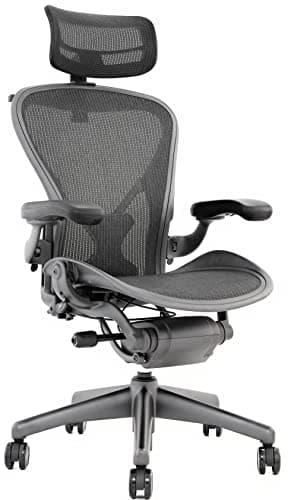
The comparison people expect is about materials and badge. That is the least useful version of it. Both chairs have a mesh back, both recline, both have adjustable arms and lumbar support, and a specification list will make them look closer than they are. The difference that matters is structural, and it shows up in the one place SIHOO cannot follow: Herman Miller sells the Aeron in three frame sizes, each with its own published seat depth, seat width, backrest height and base, while SIHOO sells one chair and asks the adjusters to cover everybody.
1. Fit chosen, or fit adjusted
Herman Miller publishes the Aeron’s dimensions per size. These are the fully adjustable arm configurations, from Herman Miller’s own specifications page:
| Aeron size | Seat depth | Seat height | Overall width | Overall height |
|---|
| A (small) | 16″ | 14.4″–19.3″ | 27.5″–29.3″ | 34.2″–38.5″ |
| B (medium) | 17″ | 14.8″–22.8″ | 28.3″–30.4″ | 36.8″–41.1″ |
| C (large) | 18.5″ | 15.8″–22.8″ | 28.3″ | 40″–45.4″ |
Look at the seat depth column, because it is the one almost nobody checks and the one that decides whether a chair hurts. Seat depth has to clear your thigh length: too deep and the front edge presses behind your knee and cuts circulation, too shallow and your thighs lose support. The Aeron answers that with 16, 17 and 18.5 inches — two and a half inches of range that you select at purchase and that no amount of adjusting can create on a chair that does not offer it. Herman Miller also states that the three sizes vary the backrest height, the seat width, the tilt mechanism and even the base diameter, which is a different claim from “small, medium, large upholstery”.
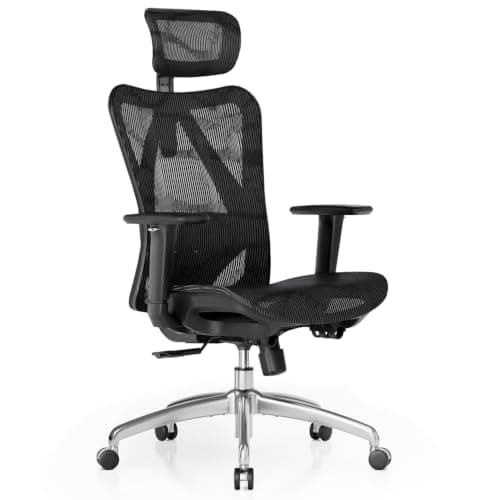
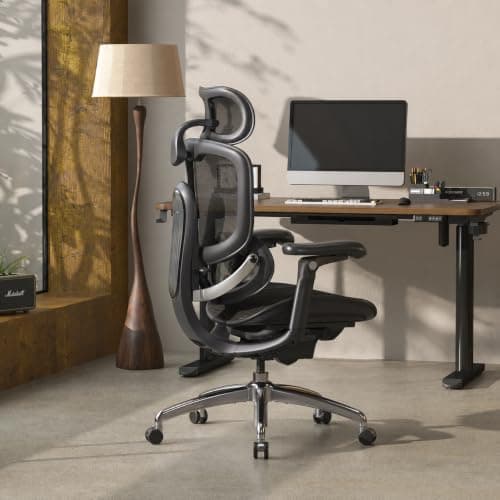
SIHOO’s answer is adjusters: a dynamic self-adjusting lumbar that tracks your spine as you move, 8D Bionic armrests, a 3D headrest and three recline positions at 105, 120 and 135 degrees. That is a lot of adjustment, and for a body near the middle of the distribution it genuinely works. What it cannot do is change the seat pan under you. If you are around 5 ft 4 in or under, or well over 6 ft, that is the sentence that decides this page — and the method for measuring yourself is in our office chair sizing guide.
2. Suspension against mesh over a frame
Both chairs are described as mesh, and they are not the same mechanism. Herman Miller publishes the Aeron’s 8Z Pellicleas an elastomeric suspension with eight zones of varied support, designed to spread load and eliminate pressure points — there is no foam in the seat at all; the material itself is the suspension. SIHOO’s backs are breathable mesh stretched over a frame with separate support hardware behind it: the dynamic lumbar on the Doro C300 Pro V2, a height-and-depth adjustable lumbar on the M57.
In practice this is a trade, not a verdict. Suspension mesh breathes better and does not develop a permanent dent where you sit; a firm suspension seat is also the thing people most often dislike about an Aeron on day one. We rank the mesh question on its own terms in the best mesh office chairs, where the test is whether the mesh is doing structural work or is a breathable cover over conventional padding.
3. Published capacity: the asymmetry runs the other way
Here the budget brand publishes the number and the premium brand does not. SIHOO states up to 330 lbfor both chairs here. Herman Miller publishes no per-size weight capacity on its Aeron specifications page, so we do not quote one — this is a gap in what is published rather than a judgment about the chair. If a stated capacity figure is something you need before buying, that is a point for SIHOO, and the general argument about capacity ratings is in office chair weight capacity.
4. Warranty, service and the cost per year
Herman Miller publishes a 12-year, 3-shift warranty with limited exceptionson the Aeron — three-shift meaning it is rated for a chair in use around the clock, not a chair used for a few hours an evening. That is the clearest thing the premium buys, and it changes the arithmetic: a chair at four figures amortized over twelve covered years is a different proposition from the same number treated as a one-off splurge.
We will not state SIHOO’s warranty term, because sihoo.com rate-limited our request every time we tried it while writing this page, so we could not read the terms at source. Check the warranty on the listing before you buy — on a chair in this price class it is the single term most worth reading, and the realistic lifespan question for both tiers is in how long office chairs last.
5. What the premium does not buy
Three honest deductions, so this does not read as a brand advert:
- Not more adjustment.SIHOO’s 8D armrests move in more directions than the Aeron’s fully adjustable arms, and the Doro’s dynamic lumbar needs no setting at all. On raw adjuster count the budget chair wins.
- Not a headrest.The Aeron does not ship one. Both SIHOO chairs here do. If you recline to read or take calls with your head back, that is a real functional gap — see office chairs with a headrest.
- Not a cure for a bad desk. No chair fixes a desk at the wrong height or a monitor below eye level. If your setup has one of those problems, the chair is not where the money should go first: desk height and monitor height come first, every time.
This premium-against-value fork repeats itself across a desk setup, and the answer is not always the same. On standing desks the premium brand publishes the longer warranty and the value brand publishes the higher capacity, which is almost the mirror image of what happens here — we work that one through in UPLIFT vs FlexiSpot.
The decision in four questions
- Measure your thigh length before anything else. If your seated thigh measurement sits outside the window a 17-inch seat pan serves, the three-size chair is not a luxury, it is the requirement. The measuring method is in the sizing guide.
- How many hours a day, for how many years? Eight hours a day for a decade is where a 12-year, 3-shift warranty and a suspension seat earn their money. Three hours an evening is not.
- Do you want a headrest? If yes, the Aeron is out of the running regardless of budget, and this comparison is over.
- What else on the desk is wrong? If your monitor is below eye level or your desk is at the standard 29 inches, a chair upgrade will not fix your neck. Fix the geometry first, then buy the chair.
Why adjuster count is the wrong way to compare chairs
Marketing counts dimensions: 3D arms, 4D arms, 8D arms. The count tells you how many axes move, not how well any of them holds position under load, and it says nothing at all about the two things that decide comfort — the shape of the seat pan under your thighs and the place the back pushes on your spine. A chair with four good adjustments that hold is better than one with eight that creep. That is also why we rank the broader field on mechanism rather than on feature lists over in the ergonomic chair rankings.
The middle route nobody mentions
There is a third answer to this question: buy neither, and buy the other premium brand. A Steelcase Series 2 sits between these two on price and publishes a 400 lb capacity and a 12-year mechanism warranty, with a flexing LiveBack instead of a suspension seat. We put the two premium brands head to head in Herman Miller vs Steelcase, and the flagship-tier version of that fight is in Aeron vs Leap V2. If you have already decided to spend premium money, read those before this page’s middle pick.
If you buy the budget chair, spend the difference on these
The honest case for the SIHOO is not just that it is cheaper; it is what the difference buys. A monitor arm fixes the screen height that no chair can, a keyboard tray fixes a desk that is too tall for your elbows, and an under-desk footrest fixes the dangling-feet problem that a tall seat creates. All three together usually cost less than the gap between these chairs, and they address problems a better chair does not touch.